Saturday, April 25, 2015

Cleaning stale files with Shake

Summary: Sometimes source files get deleted, and build products become stale. Using Shake, you can automatically delete them.

Imagine you have a build system that compiles Markdown files into HTML files for your blog. Sometimes you rename a Markdown file, which means the corresponding HTML will change name too. Typically, this will result in a stale HTML file being left, one that was previously produced by the build system, but will never be updated again. You can remove that file by cleaning all outputs and running the build again, but with the Shake build system you can do better. You can ask for a list of all live files, and delete the build products not on that list.

A basic Markdown to HTML converter

Let's start with a simple website generator. For each Markdown file, with the extension .md, we generate an HTML file. We can write that as:

import Development.Shake
import Development.Shake.FilePath

main :: IO ()
main = shakeArgs shakeOptions $ do
    action $ do
        mds <- getDirectoryFiles "." ["//*.md"]
        need ["output" </> x -<.> "html" | x <- mds]

    "output//*.html" %> \out -> do
        let src = dropDirectory1 out -<.> "md"
        need [src]
        cmd "pandoc -s -o" [out, src]

    phony "clean" $ do
        removeFilesAfter "output" ["//*.html"]

Nothing too interesting here. There are three parts:

  • Search for all .md files, and for each file foo/bar.md require output/foo/bar.html.
  • To generate an .html file, depend on the source file then run pandoc.
  • To clean everything, delete all .html files in output.

Using a new feature in Shake 0.15, we can name save this script as Shakefile.hs and then:

  • shake will build all the HTML files.
  • shake -j0 will build all the files, using one thread for each processor on our system.
  • shake output/foo.html will build just that one HTML file.
  • shake clean will delete all the HTML files.

Removing stale files

Now let's imagine we've added a blog post using-pipes.md. Before publishing we decide to rename our post to using-conduit.md. If we've already run shake then there will be a stale file output/using-pipes.html. Since there is no source .md file, Shake will not attempt to rebuild the file, and it won't be automatically deleted. We can do shake clean to get rid of it, but that will also wipe all the other HTML files.

We can run shake --live=live.txt to produce a file live.txt listing all the live files - those that Shake knows about, and has built. If we run that after deleting using-pipes.md it will tell us that using-conduit.md and output/using-conduit.md are both "live". If we delete all files in output that are not mentioned as being live, that will clean away all our stale files.

Using Shake 0.15.1 (released in the last hour) you can write:

import Development.Shake
import Development.Shake.FilePath
import Development.Shake.Util
import System.Directory.Extra
import Data.List
import System.IO

pruner :: [FilePath] -> IO ()
pruner live = do
    present <- listFilesRecursive "output"
    mapM_ removeFile $ map toStandard present \\ map toStandard live

main :: IO ()
main = shakeArgsPrune shakeOptions pruner $ do
     ... as before ...

Now when running shake --prune it will build all files, then delete all stale files, such as output/using-pipes.html. We are using the shakeArgsPrune function (just sugar over --live) which lets us pass a pruner function. This function gets called after the build completes with a list of all the live files. We use listFilesRecursive from the extra package to get a list of all files in output, then do list difference (\\) to delete all the files which are present but not live. To deal with the / vs \ path separator issue on Windows, we apply toStandard to all files to ensure they match.

A few words of warning:

  • If you run shake output/foo.html --prune then it will only pass output/foo.html and foo.md as live files, since they are the only ones that are live as you have asked for a subset of the files to be built. Generally, you want to enable all sensible targets (typically no file arguments) when passing --prune.
  • Sometimes a rule will generate something you care about, and a few files you don't really bother tracking. As an example, building a GHC DLL on Windows generates a .dll and a .dll.a file. While the .dll.a file may not be known to Shake, it probably doesn't want to get pruned. The pruning function may need a few special cases, like not deleting the .dll.a file if the .dll is live.

Thursday, March 26, 2015

New website with new talks

My website is now located at ndmitchell.com and has a few new talks on it:

My old website at community.haskell.org is going to stop being updated, and I'll be putting in redirections shortly. That server is going to stop hosting websites, so I bought myself a domain name and setup a GitHub pages website. The repo is here, including all the data, metadata, templates and scripts.

Sunday, March 22, 2015

Finding a GHC bug

Summary: I found a nasty bug in GHC 7.10 RC3. It's been fixed.

For Shake, I have an extensive test suite (2500+ lines of tests). I also test on 7 GHC versions, including GHC HEAD. After adding GHC 7.10 Release Candidate 3 to the mix one of the tests started failing. A week later the bug has been simplified, diagnosed and fixed as bug #10176. Below is a tale of how that happened, including a technical explanation of the bug in Step 8.

Step 1: Write a lot of tests

The Shake test that caught this particular bug checks that if the user makes a mistake then the error message must contain certain substrings correctly identifying the problem. With GHC 7.10 RC3 on Travis this test stopped throwing an exception entirely, continuing as though nothing were wrong. Weird.

Step 2: Reproduce locally

I tried to reproduce the failure locally, which ended up spotting a fatal bug in the GHC 7.10 RC3 32bit Windows version. After opting for the 64bit version, at first I couldn't reproduce the error. Eventually I realised that you needed to turn on optimisation (at -O1), and that running through ghci (how I usually develop Haskell) didn't cause the problem. Noticing that -O1 was required gave me a clue, that it was related to an optimisation. The typical cause of programs that work without optimisation but fail with it are programs that raise exceptions in pure code (since the exception can change due to optimisations) or those that call unsafePerformIO (it has unsafe in the name for a reason). I certainly do both those things in Shake, but I wasn't aware of anywhere I did them in a dubious manner.

Step 3: Reduce the test case

I spent a lot of time trying to reduce the test case. By inserting print statements I narrowed the place the difference was happening to Development.Shake.Core.applyKeyValue, which is a pretty core bit of Shake. However, while I was able to chop out a lot of auxiliary features (lint tracking, command tracing) the actual code remained difficult to reduce to any great extent, for two reasons. Firstly, the bug was incredibly fragile - moving a monomorphic NOINLINE function from one module to another made the bug disappear. Secondly, the applyKeyValue function is right in the middle of Shake, and the test required a few successful Shake runs to set up things for the failing test, so I couldn't change its observable semantics too much.

What I did conclude was that Shake didn't seem to be doing anything dodgy in the small patch of code that seemed relevant, giving me the first hint that maybe GHC was at fault, not Shake.

Step 4: Differences at the Core level

At this point, I reached out to the GHC mailing list, asking if anyone had any ideas of a culprit. They didn't, but Simon Peyton Jones suggested finding the smallest breaking change and comparing the generated Core. You can do that by compiling with -ddump-simpl, and adding -dsuppress-all -dsuppress-uniques to get something a bit easier to diff. Fortunately, by this point I had a very small change to make the error appear/disappear (moving a function from one module to another), so the difference in Core was tiny. The change in the problematic version read:

case (\_ -> error "here") of {}

In GHC Core a case always evaluates its scrutinee until it has the outermost value available (aka WHNF). The empty alternatives mean that GHC has proven that the evaluation always results in an exception. However, a lambda already has a value available (namely the lambda) so evaluation never throws an exception. As a result, GHC has violated the rules of Core and bad things happen.

Step 5: Reducing further

In order to reduce the bug further I now had a better test, namely:

ghc Core.hs -O -ddump-simpl | grep -F "case (\\"

With this test I didn't have to keep the internals of Shake working, and in fact didn't even have to provide a runnable entry point - all I had to do was look for the dodgy construction in the Core language. Note that I'm not actually looking for case of a lambda with empty alternatives, reasoning (seemingly correctly) that any case on a lambda with non-empty alternatives would be eliminated by the GHC simplifier, so any case followed by lambda is buggy.

I reduced by having a ghcid Window open in one corner, using the warnings -fwarn-unused-binds and -fwarn-unused-imports. I hacked out some part of the program and then patched everything up so it no longer raised an error using ghcid for rapid feedback. I then ran the grep test. If the bug had gone I put the program back to how it was and tried somewhere else. If the bug remained I then cleaned up the now redundant declarations and imports and checked again, repeating until the code was minimal.

Several hours later I was left with something like:

buggy :: (() -> Bool) -> () -> Bool -> IO ()
buggy fun unit bool =
    runReaderT (
        (if bool then liftIO $ print () else p) >>
        (if fun unit then error2Args unit unit >> p else p)) ()

{-# NOINLINE error2Args #-}
error2Args :: () -> () -> a
error2Args _ _ = error "here"

Note that error2Args must be in a different module to buggy.

Step 6: Bisecting

At this point hvr stepped in and bisected all the changes between GHC 7.10 RC2 and RC3, determining that a large Typeable change introduced the bug in the original shake test case. However, using the minimal program, the bug was also present in GHC 7.10 RC2. That suggested the bug might have been around for a while.

Step 7: Augmenting GHC's Lint Checker

GHC already has a pass in the compiler, enabled with -dcore-lint, which checks for dodgy constructs in the Core language. Enabling it didn't pick up this example (hence I used grep instead), so Joachim Breitner added such a check. He also added the example as a test case, so that if it ever breaks in future things it will be spotted immediately.

Step 8: Diagnose and Fix

Joachim then continued to diagnose and fix the issue, the details of which can be found in the patch. The problem (as I understand it) is that GHC looks at the code:

fun x = error "foo" x

And concludes two facts.

  1. If fun is called with one argument then the code will raise an error. That's true, and allows the compiler to replace fun () () with fun ().
  2. After analysing all calls of fun it spots that fun is always called with two arguments, so it is free to change fun to be fun x y = error "foo" x y.

By applying these two facts, we can make the transformation:

case fun () () of {}
-- apply the first rule
case fun () of {}
-- inline fun after applying the second rule
case (\x y -> error "foo" x y) () of {}
-- beta reduce:
case (\y -> error "foo" () y) of {}

Now we have caused invalid Core to be produced. While the two facts are each individually correct, applying the first fact causes the second fact to stop being true. Joachim fixed this by making the call argument count analysis stop at the first argument that guarantees an error.

Step 9: The Impact

The manifestation of the bug is quite interesting. Essentially GHC decides something is an error, but then fails to actually throw the error. As a result, any code the simplifier places after the error call will be eliminated, and that can remove a large chunk of the program. However, any code the simplifier doesn't manage to hoist next to the code will still get run, even though it should have been skipped due to an error. In essence, given exactly the wrong conditions to trigger the bug, you can write:

main = do
    putStrLn "here1"
    ... error "foo" ...
    putStrLn "here2"
    ...
    putStrLn "here3"

And end up with the program printing here1 followed by here3, without throwing an exception. In the case of my original Shake test it started to compile, should have stopped with an error but instead just skipped compiling altogether and went on to do the bits after compiling. A very weird manifestation.

Disclaimer: I've eliminating many missteps of mine, which included pushing random patches to try and reduce on the Travis machine and installing a Linux VM.

Monday, March 09, 2015

Implementing a Functor instance

Summary: Implementing a Functor instance is much easier than implementing a Monad instance, and can turn out to be quite useful.

Haskell forces all programmers to understand some details of the Monad typeclass to do basic IO, but currently nothing forces people to learn the Functor typeclass. However, Functor is much simpler than Monad, and all Monads must be Functors, so thinking more about Functor can be a nice route to understanding Monad better.

An intuitive description of a functor is:

A container whose contents can be replaced, without changing the shape of the container.

Some example functors include lists and Maybe. Both contain values, and you can replace the values inside them. In fact, most types with a single type parameter can be made functors. For example, in CmdArgs I define something similar to:

data Group a = Group {groupUnnamed :: [a], groupNamed :: [(String, [a])]}

This Group structure contains a values inside it. Sometimes it is useful to transform all the underlying a values, perhaps to a different type. The Functor instance has a single member:

fmap :: Functor f => (a -> b) -> f a -> f b

For the above type, we instantiate f to Group so we get:

fmap :: (a -> b) -> Group a -> Group b

We can implement fmap by applying f to every a value inside Group:

instance Functor Group where
    fmap f (Group a b) = Group (map f a) [(x, map f y) | (x,y) <- b]

Note in particular that Group is usually written Group a, but in the instance declaration we're omitting the a, to say Group itself (without any arguments) is a functor. Providing insufficient type arguments like that makes Functor a higher-kinded type class, in contrast to those like Eq or Ord which would have been on Group a.

When implementing fmap the type checker eliminates most bad implementations, so the only law you need to think about is that fmap id = id - given the identity function, the value shouldn't change. We can show this law for Group with:

Group a b = fmap id (Group a b)
-- inline fmap
Group a b = Group (map id a) [(x, map id y) | (x,y) <- b]
-- map id x ==> x
Group a b = Group a [(x, y) | (x,y) <- b]
-- simplify list comprehension
Group a b = Group a b
-- equal

In fact, the function map is just fmap specialised to [], so the rule map id x ==> x is just applying the fmap id = id law on lists. From this law, we can derive the additional law that:

fmap (f . g)  ==  fmap f . fmap g

Both these laws can serve as the basis for optimisation opportunities, reducing the number of times we traverse a value, and GHC exploits these laws for the list type.

In general, most data types that take a type parameter can be made functors, but there are a few common exceptions:

  • You have a value on the left of an arrow – for example data Foo a = Foo (a -> Int) cannot be made a functor, since we have no way to change the incoming b back to an a.
  • You have an invariant relating the structure and the elements. For example data OrdList a = Nil | Gt a (OrdList a), where all functions on OrdList have an Ord context, and OrdList is exported abstractly. Here the functor would break the abstraction.
  • You require an instance for the element type, e.g. Data.Vector.Storable requires a Storable instance to create a vector, which Functor does not allow.

The name functor may sound scary, or confusing to C++ programmers (who accidentally say functor to mean function) – but they are a nice simple abstraction.

Wednesday, February 25, 2015

Making withSocketsDo unnecessary

Summary: Currently you have to call withSocketsDo before using the Haskell network library. In the next version you won't have to.

The Haskell network library has always had a weird and unpleasant invariant. Under Windows, you must call withSocketsDo before calling any other functions. If you forget, the error message isn't particularly illuminating (e.g. getAddrInfo, does not exist, error 10093). Calling withSocketsDo isn't harmful under Linux, but equally isn't necessary, and thus easy to accidentally omit. The network library has recently merged some patches so that in future versions there is no requirement to call withSocketsDo, even on Windows.

Existing versions of network

The reason for requiring withSocketsDo is so that the network library can initialise the Windows Winsock library. The code for withSocketsDo was approximately:

withSocketsDo :: IO a -> IO a
#if WINDOWS
withSocketsDo act = do
    initWinsock
    act `finally` termWinsock
#else
withSocketsDo act = act
#endif

Where initWinsock and termWinsock were C functions. Both checked a mutable variable so they only initialised/terminated once. The initWinsock function immediately initialised the Winsock library. The termWinsock function did not terminate the library, but merely installed an atexit handler, providing a function that ran when the program shut down which terminated the Winsock library.

As a result, in all existing versions of the network library, it is fine to nest calls to withSocketsDo, call withSocketsDo multiple times, and to perform networking operations after withSocketsDo has returned.

Future versions of network

My approach to removing the requirement to call withSocketsDo was to make it very cheap, then sprinkle it everywhere it might be needed. Making such a function cheap on non-Windows just required an INLINE pragma (although its very likely GHC would have always inlined the function anyway).

For Windows, I changed to:

withSocketsDo act = do evaluate withSocketsInit; act 

{-# NOINLINE withSocketsInit #-}
withSocketsInit = unsafePerformIO $ do
    initWinsock
    termWinsock

Now withSocketsDo is very cheap, with subsequent calls requiring no FFI calls, and thanks to pointer tagging, just a few cheap instructions. When placing additional withSocketsDo calls my strategy was to make sure I called it before constructing a Socket (which many functions take as an argument), and when taking one of the central locks required for the network library. In addition, I identified a few places not otherwise covered.

In newer versions of the network library it is probably never necessary to call withSocketsDo - if you find a place where one is necessary, let me know. However, for compatibility with older versions on Windows, it is good practice to always call withSocketsDo. Libraries making use of the network library should probably call withSocketsDo on their users behalf.

Tuesday, February 17, 2015

nub considered harmful

Summary: Don't use nub. A much faster alternative is nubOrd from the extra package.

The Haskell Data.List module contains the function nub, which removes duplicate elements. As an example:

nub [1,2,1,3] ==  [1,2,3]

The function nub has the type Eq a => [a] -> [a]. The complexity of take i $ nub xs is O(length xs * i). Assuming all elements are distinct and you want them all, that is O(length xs ^ 2). If we only have an Eq instance, that's the best complexity we can achieve. The reason is that given a list as ++ [b], to check if b should be in the output requires checking b for equality against nub as, which requires a linear scan. Since checking each element requires a linear scan, we end up with a quadratic complexity.

However, if we have an Ord instance (as we usually do), we have a complexity of O(length xs * log i) - a function that grows significantly slower. The reason is that we can build a balanced binary-tree for the previous elements, and check each new element in log time. Does that make a difference in practice? Yes. As the graph below shows, by the time we get to 10,000 elements, nub is 70 times slower. Even at 1,000 elements nub is 8 times slower.


The fact nub is dangerous isn't new information, and I even suggested changing the base library in 2007. Currently there seems to be a nub hit squad, including Niklas Hambüchen, who go around raising tickets against various projects suggesting they avoid nub. To make that easier, I've added nubOrd to my extra package, in the Data.List.Extra module. The function nubOrd has exactly the same semantics as nub (both strictness properties and ordering), but is asymptotically faster, so is almost a drop-in replacement (just the additional Ord context).

For the curious, the above graph was generated in Excel, with the code below. I expect the spikes in nub correspond to garbage collection, or just random machine fluctuations.

import Control.Exception
import Data.List.Extra
import Control.Monad
import System.Time.Extra

benchmark xs = do
    n <- evaluate $ length xs
    (t1,_) <- duration $ evaluate $ length $ nub xs
    (t2,_) <- duration $ evaluate $ length $ nubOrd xs
    putStrLn $ show n ++ "," ++ show t1 ++ "," ++ show t2

main = do
    forM_ [0,100..10000] $ \i -> benchmark $ replicate i 1
    forM_ [0,100..10000] $ \i -> benchmark [1..i]

Tuesday, February 10, 2015

Why is the Hoogle index so out of date?

Summary: Hoogle 4 is out of date. The alpha version Hoogle 5 has fresh code and data every day (and isn't yet ready).

Someone recently asked why Hoogle's index is so out of date. Making the index both more current (updated daily) and larger (indexing all of Stackage) is one of the goals behind my Hoogle 5 rewrite (which still isn't finished). Let's compare the different update processes:

Hoogle 4 updates took about two hours to complete, if they went well, and often had to be aborted. I first compiled the Hoogle binary on the haskell.org machines, which often failed, as typically the version of GHC was very old. Once I'd got a compiled binary, I needed to generate the database, which took about 2 hours, and occasionally failed halfway through. Once I had the new binary and databases I moved everything to correct place for Apache, accepting a small window of downtime during the move. Assuming that worked, I did a few test searches and smiled. Often the new Hoogle binary failed to start (usually failure to find some files, sometimes permissions) and I had to switch back to the old copy. Fixing up such issues took up to an hour. I had a mix of Windows .bat and Linux .sh scripts to automate some of the steps, but they weren't very robust, and required babysitting.

Hoogle 5 updates happen automatically at 8pm every night, take 4 minutes, and have yet to fail. I have a cron script that checks out the latest code and runs an update script. That script clones a fresh repo, compiles Hoogle, builds the databases, runs the test suite, kills the old version and launches the new version. The Hoogle code is all tested on Travis, so I don't expect that to fail very often. The upgrade script is hard to test, but the two failure modes are upgrading to a broken version, or not upgrading. The upgrade script runs checks and fails if anything doesn't work as expected, so it errs on the side of not upgrading. I use Uptime Robot to run searches and check the server is working, along with a canary page which raises an error if no upgrade happens for two days.

Clearly, the Hoogle 5 version update story is better. But why didn't I do it that way with Hoogle 4? The answer is that Hoogle 4 came out over six years ago, and a lot has changed since then:

  • Hoogle 4 is a CGI binary, served through Apache, while Hoogle 5 is a Haskell Warp server. By moving the logic into Haskell, it's far easier for me to configure and manage. Warp was only released on Hackage in 2011.
  • Hoogle 4 runs on the on the main haskell.org server, where my mistakes can easily take out the haskell.org home page (as a result, the haskell.org home page once said "moo" for 10 minutes). Hoogle 5 runs on a dedicated VM where I have root, and no one else runs anything, so I can experiment with settings about swap files, IP tables and cron jobs.
  • My job has provided a lot of practice doing drive-by sysadmining over the last 6 years. I've also had a lot of practice doing critical releases on a nightly basis. In comparison, Hoogle is pretty simple.
  • The revised/rethought approach to Hoogle databases is a lot faster and uses a lot less memory, so it takes under a minute to generate databases, instead of over an hour. That time difference makes it much easier to experiment with different approaches.

When will Hoogle 5 be ready? It doesn't yet do type search, there is no offline version and no API. There are probably lots of other little pieces missing. If you want, feel free to use it now at hoogle.haskell.org. You can still use Hoogle 4 at haskell.org/hoogle, or the more up-to-date FP complete hosted Hoogle 4.

Thursday, February 05, 2015

Refactoring with Equational Reasoning

Summary: Haskell is great for refactoring, thanks to being able to reason about and transform programs with confidence.

I think one of Haskell's strengths as a practical language is that it's easy to refactor, and more importantly, easy to refactor safety. Programs in the real world often accumulate technical debt - code that is shaped more by its history than its current purpose. Refactoring is one way to address that technical debt, making the code simpler, but not changing any meaningful behaviour.

When refactoring, you need to think of which alternative forms of code are equivalent but better. In C++ I've removed unused variables, only to find they were RAII variables, and their mere presence had a semantic effect. In R I've removed redundant if expressions, only to find the apparently pure condition had the effect of coercing a variable and changing its type. In Haskell, it's equally possible to make refactorings that at first glance appear safe but aren't - however, in practice, it happens a lot less. I think there are a few reasons for that:

  • Haskell is pure and evaluation strategy is largely unobservable - moving a statement "before" or "after" another lexically is usually safe.
  • Refactorings that do go wrong, for example variables that accidentally get moved out of scope or types which are no longer as constrained, usually result in compiler errors.
  • The Haskell community cares about semantics and laws. The Monad laws are satisfied by almost all monads, flagrantly breaking those laws is rare.
  • Functions like unsafePerformIO, which could harm refactoring, are almost always used behind a suitable pure abstraction.

Note that these reasons are due to both the language, and the conventions of the Haskell community. (Despite these factors, there are a few features that can trip up refactorings, e.g. exceptions, record wildcards, space-leaks.)

To take a very concrete example, today I was faced with the code:

f = fromMaybe (not b) . select
if f v == b then opt1 else opt2

At one point the function f was used lots, had a sensible name and nicely abstracted some properties. Now f is used once, the semantics are captured elsewhere, and the code is just unclear. We can refactor this statement, focusing on the condition:

f v == b
-- inline f
(fromMaybe (not b) . select) v == b
-- remove brackets and inline (.)
fromMaybe (not b) (select v) == b
-- expand to a case statement
(case select v of Nothing -> not b; Just x -> x) == b
-- push the == down
case select v of Nothing -> not b == b; Just x -> x == b
-- simplify not b == b
case select v of Nothing -> False; Just x -> x == b
-- collapse back up
select v == Just b

And now substitute back in:

if select v == Just b then opt1 else opt2

Our code is now much simpler and more direct. Thanks to the guarantees I expect of Haskell programs, I also have a high degree of confidence this code really is equivalent - even if it isn't obvious just looking at beginning and end.

Tuesday, January 27, 2015

Hoogle 5 is coming

Summary: I'm working on Hoogle 5. If you like unfinished software, you can try it.

For the last month I've been working on the next version of Hoogle, version 5. It isn't finished, and it isn't the "official" version of Hoogle yet, but it's online, you can try it out, and anyone who wants to hack on Hoogle (or things like hoogle-index) should probably take a look now.

How do I try it?

The purpose of this blog post isn't to solicit beta testers, it's not ready for that - I'm mostly reaching out to Hoogle developers. That said, I know some people will want to try it, so it's online at hoogle.haskell.org. Beware, it isn't finished, and haskell.org/hoogle remains the "official" version to use (but hey, use whichever you want, or both, or neither).

What's new for users of the website?

  • It isn't finished. In particular, type search hasn't been implemented. But there are also lots of other pieces in all the corners that don't work properly.
  • It searches all the packages on Stackage by default.
  • There is a drop-down to allow you to restrict focus to only a single package, or an author, or a tag.

What's new for everyone else?

  • There is no library, it's not on Hackage and the command line tool isn't designed for users. These things will be coming over time.
  • It's hosted on a haskell.org virtual machine, served through Warp rather than as a CGI program. Thanks to the Haskell Infrastructure team for all their help. As a result, I'm free to experiment with Hoogle without accidentally making the Haskell homepage say "moo".
  • Generating database for all of Stackage (minus download time) takes about 40s and uses < 1Gb of memory. The databases are built directly out of the .tar.gz files, without unpacking them.

What's next?

Update: the hogle code is now on the master branch of the hoogle repo, and the hoogle v4 code is on branch hoogle4.

Hoogle 5 is a complete rewrite of Hoogle, stealing bits as they were useful. At the moment Hoogle 4 is hosted at https://github.com/ndmitchell/hoogle while version 5 is at https://github.com/ndmitchell/hogle. The next step is to rename and move github repos so they are sensible once again. My best guess is that I should rename hoogle to hoogle4, then rename hogle to hoogle and move the issue tickets. I'm open to other suggestions.

Once that's resolved, I need to continue fixing and improving Hoogle so all the things that aren't finished become finished. If you are interested in helping, I recommend you create a github ticket describing what you want to do and we can take it from there.

Tuesday, January 13, 2015

User Interfaces for Users

Summary: When designing a user interface, think about the user, and what they want to know. Don't just present the information you know.

As part of my job I've ended up writing a fair amount of user interface code, and feedback from users has given me an appreciation of some common mistakes. Many user interfaces are designed to present information, and one of the key rules is to think about what the user wants to see, not just showing the information you have easily to hand. I was reminded of this rule when I was expecting a parcel. On the morning of Saturday 10/1/2015 I used a track my parcel interface to find:

The interface presents a lot of information, but most of it is interesting to the delivery company, not to me. I have basically one question: when will my parcel arrive. From the interface I can see:

  • The parcel is being shipped with "Express AM" delivery. No link to what that means. Searching leads me to a page saying that guarantees delivery before 1pm on a business day (some places said noon, some said 1pm). That is useful information if I want to enter into a contract with the delivery service, but not when I'm waiting for a parcel. What happens on Saturday? Do they still deliver, just not guarantee the time? Do they wait until the next business day? Do they do either, as they see fit?
  • My parcel has been loaded onto a vehicle. Has the vehicle has left the depot, or is that a separate step? How many further steps are there between loading and delivery? This question is easy to answer after the parcel has been delivered, since the additional steps show up in the list, but difficult to answer before.

On Saturday morning my best guess about when the parcel would arrive was between then and Monday 1pm. Having been through the complete process, I now know the best answer was between some still unknown time on Monday morning and Monday 1pm. With that information, I'd have taken my son to the park rather than keeping him cooped up indoors.

I suggest the company augment their user interface with the line "Your parcel will be delivered on Monday, between 9am and 1pm". It's information they could have computed easily, and answers my question.

The eagle-eyed may notice that there is a plus to expand to show more information. Alas, all that shows is:

I think they're trying to say my puny iPhone can't cope with the bold font that is essential to tell me the status and I should get an iPhone plus... Checking the desktop website also showed no further information.

Wednesday, December 10, 2014

Beta testing the Windows Minimal GHC Installer

Summary: There is now a minimal Windows GHC installer that can install the network library.

Michael Snoyman and I are seeking beta testers for our new Windows GHC installer. The installer is very new, and we're keen to get feedback.

Update: If you want to install to Program Files (the default installation path), download the file, right click and hit "Run as administrator". This will be automatic in the next version.

One of the standard problems when upgrading Haskell libraries on Windows is that sometimes you have to upgrade a package which requires a configure script - typically the network library. When that happens, you have to take special measures, and even then, sometimes the binary will fail at runtime (this happens on about half my machines).

Our installer solves that problem by bundling GHC, Cabal and MSYS in one installer. You can install the network library out of the box without any special configuration and it just works.

Our installer does not provide all the packages included with the Haskell Platform, but it does provide an environment where you can easily install those packages. This minimal installer might be more suitable for developers.

Why might I want this installer

The installer is much easier to install than the GHC distribution (has a real installer, sets up the %PATH%, includes Cabal and can build the network library).

The installer has less libraries than the Haskell Platform installer, but includes MSYS so you can build everything in the Platform. The lack of additional packages and close correspondence with GHC (there is one installer for each GHC version) might make it more suitable for library developers. Once GHC 7.10.1 is released, we hope to make a GHC Minimal Installer available within days.

The installer also has more precise control over what is added to the %PATH%. You can add all the binaries it provides, or just add a single binary minghc-7.8.3 which when run at the command prompt temporarily adds all the installed binaries to the %PATH%. Using the switcher, you can easily switch GHC versions.

Wednesday, November 19, 2014

Announcing Shake 0.14

Summary: Shake 0.14 is now out. The *> operator became %>. If you are on Windows the FilePath operations work differently.

I'm pleased to announce Shake 0.14, which has one set of incompatible changes, one set of deprecations and some new features.

The *> operator and friends are now deprecated

The *> operator has been the Shake operator for many years, but in GHC 7.10 the *> operator is exported by the Prelude, so causes name clashes. To fix that, I've added %> as an alias for *>. I expect to export *> for the foreseeable future, but you should use %> going forward, and will likely have to switch with GHC 7.10. All the Shake documentation has been updated. The &*> and |*> operators have been renamed &%> and |%> to remain consistent.

Development.Shake.FilePath now exports System.FilePath

Previously the module Development.Shake.FilePath mostly exported System.FilePath.Posix (even on Windows), along with some additional functions, but modified normalise to remove /../ and made </> always call normalise. The reason is that if you pass non-normalised FilePath values to need Shake can end up with two names for one on-disk file and everything goes wrong, so it tried to avoid creating non-normalised paths.

As of 0.14 I now fully normalise the values inside need, so there is no requirement for the arguments to need to be normalised already. This change allows the simplification of directly exporting System.FilePath and only adding to it. If you are not using Windows, the changes are:

  • normalise doesn't eliminate /../, but normaliseEx does.
  • </> no longer calls normalise. It turned out calling normalise is pretty harmful for FilePattern values, which leads to fairly easy-to-make but hard-to-debug issues.

If you are using Windows, you'll notice all the operations now use \ instead of /, and properly cope with Windows-specific aspects like drives. The function toStandard (convert all separators to /) might be required in a few places. The reasons for this change are discussed in bug #193.

New features

This release has lots of new features since 0.13. You can see a complete list in the change log, but the most user-visible ones are:

  • Add getConfigKeys to Development.Shake.Config.
  • Add withTempFile and withTempDir for the Action monad.
  • Add -j to run with one thread per processor.
  • Make |%> matching with simple files much faster.
  • Use far less threads, with corresponding less stack usage.
  • Add copyFileChanged.

Plans

I'm hoping the next release will be 1.0!

Thursday, November 13, 2014

Operators on Hackage

Summary: I wrote a script to list all operators on Hackage, and which packages they are used by.

In GHC 7.10 the *> operator will be moving into the Prelude, which means the Shake library will have to find an alternative operator (discussion on the mailing list). In order to pick a sensible operator, I wanted to list all operators in all Hackage packages so I could be aware of clashes.

Note that exported operators is more than just those defined by the package, e.g. Shake exports the Eq class, so == is counted as being exported by Shake. However, in most cases, operators exported by a package are defined by that package.

Producing the file

First I downloaded the Hoogle databases from Hackage, and extracted them to a directory named hoogle. I then ran:

ghc --make Operators.hs && operators hoogle operators.txt

And uploaded operators.txt above. The code for Operators.hs is:

import Control.Exception.Extra
import Control.Monad
import Data.List.Extra
import System.Directory.Extra
import System.Environment
import System.FilePath
import System.IO.Extra

main = do
    [dir,out] <- getArgs
    files <- listFilesRecursive dir
    xs <- forM files $ \file -> do
        src <- readFileUTF8' file `catch_` \_ -> readFile' file `catch_` \_ -> return ""
        return [("(" ++ takeWhile (/= ')') x ++ ")", takeBaseName file) | '(':x <- lines src]
    writeFileUTF8 out $ unlines [unwords $ a : nub b | (a,b) <- groupSort $ concat xs]

This code relies on the normal packages distributed with GHC, plus the extra package.

Code explanation

The script is pretty simple. I first get two arguments, which is where to find the extracted files, and where to write the result. I then use listFilesRecursive to recursively find all extracted files, and forM to loop over them. For each file I read it in (trying first UTF8, then normal encoding, then giving up). For each line I look for ( as the first character, and form a list of [(operator-name, package)].

After producing the list, I use groupSort to produce [(operator-name, [package])] then writeFileUTF8 to produce the output. Running the script takes just over a minute on my ancient computer.

Writing the code

Writing the code to produce the operator list took about 15 minutes, and I made some notes as I was going.

  • I started by loading up ghcid for the file with the command line ghcid -t -c "ghci Operators.hs". Now every save immediately resulted in a list of warnings/errors, and I never bothered opening the file in ghci, I just compiled it to test.
  • I started by inserting take 20 files so I could debug the script faster and could manually check the output was plausible.
  • At first I wrote takeBaseName src rather than takeBaseName file. That produced a lot of totally incorrect output, woops.
  • At first I used readFile to suck in the data and putStr to print it to the console. That corrupted Unicode operators, so I switched to readFileUTF8' and writeFileUTF8.
  • After switching to writeFileUTF8 I found a rather serious bug in the extra library, which I fixed and added tests for, then made a new release.
  • After trying to search through the results, I added ( and ) around each operator to make it easier to search for the operators I cared about.

User Exercise

To calculate the stats of most exported operator and package with most operators I wrote two lines of code - how would you write such code? Hint: both my lines involved maximumBy.

Tuesday, November 11, 2014

Upper bounds or not?

Summary: I thought through the issue of upper bounds on Haskell package dependencies, and it turns out I don't agree with anyone :-)

There is currently a debate about whether Haskell packages should have upper bounds for their dependencies or not. Concretely, given mypackage and dependency-1.0.2, should I write dependency >= 1 (no upper bounds) or dependency >= 1 && < 1.1 (PVP/Package versioning policy upper bounds). I came to the conclusion that the bounds should be dependency >= 1, but that Hackage should automatically add an upper bound of dependency <= 1.0.2.

Rock vs Hard Place

The reason the debate has continued so long is because both choices are unpleasant:

  • Don't add upper bounds, and have packages break for your users because they are no longer compatible.
  • Add PVP upper bounds, and have reasonable install plans rejected and users needlessly downgraded to old versions of packages. If one package requires a minimum version of above n, and another requires a maximum below n, they can't be combined. The PVP allows adding new functions, so even if all your dependencies follow the PVP, the code might still fail to compile.

I believe there are two relevant relevant factors in choosing which scheme to follow.

Factor 1: How long will it take to update the .cabal file

Let us assume that the .cabal file can be updated in minutes. If there are excessively restrictive bounds for a few minutes it doesn't matter - the code will be out of date, but only by a few minutes, and other packages requiring the latest version are unlikely.

As the .cabal file takes longer to update, the problems with restrictive bounds become worse. For abandoned projects, the restrictive upper bounds make them unusable. For actively maintained projects with many dependencies, bounds bumps can be required weekly, and a two week vacation can break actively maintained code.

Factor 2: How likely is the dependency upgrade to break

If upgrading a dependency breaks the package, then upper bounds are a good idea. In general it is impossible to predict whether a dependency upgrade will break a package or not, but my experience is that most packages usually work fine. For some projects, there are stated compatibility ranges, e.g. Snap declares that any API will be supported for two 0.1 releases. For other projects, some dependencies are so tightly-coupled that every 0.1 increment will almost certainly fail to compile, e.g. the HLint dependency on Haskell-src-exts.

The fact that these two variable factors are used to arrive at a binary decision is likely the reason the Haskell community has yet to reach a conclusion.

My Answer

My current preference is to normally omit upper bounds. I do that because:

  • For projects I use heavily, e.g. haskell-src-exts, I have fairly regular communication with the maintainers, so am not surprised by releases.
  • For most projects I depend on only a fraction of the API, e.g. wai, and most changes are irrelevant to me.
  • Michael Snoyman and the excellent Stackage alert me to broken upgrades quickly, so I can respond when things go wrong.
  • I maintain quite a few projects, and the administrative overhead of uploading new versions, testing, waiting for continuous-integration results etc would cut down on real coding time. (While the Hackage facility to edit the metadata would be quicker, I think that tweaking fundamentals of my package, but skipping the revision control and continuous integration, seems misguided.)
  • The PVP is a heuristic, but usually the upper bound is too tight, and occasionally the upper bound is too loose. Relying on the PVP to provide bounds is no silver bullet.

On the negative side, occasionally my packages no longer compile for my users (very rarely, and for short periods of time, but it has happened). Of course, I don't like that at all, so do include upper bounds for things like haskell-src-exts.

The Right Answer

I want my packages to use versions of dependencies such that:

  • All the features I require are present.
  • There are no future changes that stop my code from compiling or passing its test suite.

I can achieve the first objective by specifying a lower bound, which I do. There is no way to predict the future, so no way I can restrict the upper bound perfectly in advance. The right answer must involve:

  • On every dependency upgrade, Hackage (or some agent of Hackage) must try to compile and test my package. Many Haskell packages are already tested using Travis CI, so reusing those tests seems a good way to gauge success.
  • If the compile and tests pass, then the bounds can be increased to the version just tested.
  • If the compile or tests fail, then the bounds must be tightened to exclude the new version, and the author needs to be informed.

With this infrastructure, the time a dependency is too tight is small, and the chance of breakage is unknown, meaning that Hackage packages should have exact upper bounds - much tighter than PVP upper bounds.

Caveats: I am unsure whether such regularly changing metadata should be incorporated into the .cabal file or not. I realise the above setup requires quite a lot of Hackage infrastructure, but will buy anyone who sorts it out some beer.

Sunday, November 02, 2014

November talks

Summary: I'll be talking at CodeMesh 2014 on 5th November and FP Days on 20th November.

I am giving two talks in London this month:

CodeMesh 2014 - Gluing Things Together with Haskell, 5th Nov

I'll be talking about how you can use Haskell as the glue language in a project, instead of something like Bash. In particular, I'll cover Shake, NSIS and Bake. The abstract reads:

A large software project is more than just the code that goes into a release, in particular you need lots of glue code to put everything together - including build systems, test harnesses, installer generators etc. While the choice of language for the project is often a carefully considered decision, more often than not the glue code consists of shell scripts and Makefiles. But just as functional programming provides a better way to write the project, it also provides a better way to write the glue code. This talk covers some of the technologies and approaches we use at Standard Chartered to glue together the quant library. In particular, we'll focus on the build system where we replaced 10,000 lines of Makefiles with 1,000 lines of Haskell which builds the project twice as fast. We'll also look at how to test programs using Haskell, how to replace ancillary shell scripts with Haskell, and how to use Haskell to generate installers.

FP Days 2014 - Building stuff with Shake, 20th Nov

I'll be giving a tutorial on building stuff with Shake. It's going to be less sales pitch, more how you structure a build system, and how you use Shake effectively. The abstract reads:

Build systems are a key part of any large software project, relied upon by both developers and release processes. It's important that the build system is understandable, reliable and fast. This talk introduces the Shake build system which is intended to help meet those goals. Users of Shake write a Haskell program which makes heavy use of the Shake library, while still allowing the full power of Haskell to be used. The Shake library provides powerful dependency features along with useful extras (profiling, debugging, command line handling). This tutorial aims to help you learn how to think about writing build systems, and how to make those thoughts concrete in Shake.

Sunday, October 19, 2014

HLint now spots bad unsafePerformIO

Summary: I've just released a new version of HLint that can spot an unsafePerformIO which should have NOINLINE but doesn't.

I've just released HLint v1.9.10, a tool to suggest improvements to Haskell code. I don't usually bother with release announcements of HLint, as each version just fixes a few things and adds a few hints, it's all in the changelog (plus there have now been 102 releases). The latest release attempts to make using unsafePerformIO a little bit safer. A common idiom for top-level mutable state in Haskell is:

myGlobalVar :: IORef Int
myGlobalVar = unsafePerformIO (newIORef 17)

That is, define a top-level CAF (function with no variables) and bind it to unsafePerformIO of some created mutable state. But the definition above is unsafe. GHC might decide myGlobalVar is cheap and inline it into several uses, duplicating the variable so that some functions update different versions. Running this code through the latest version of HLint we see:

Sample.hs:2:1: Error: Missing NOINLINE pragma
Found:
  myGlobalVar = unsafePerformIO (newIORef 17)
Why not:
  {-# NOINLINE myGlobalVar #-}
  myGlobalVar = unsafePerformIO (newIORef 17)

HLint has spotted the problem, and suggested the correct fix.

Trying it for real

Let's take the package slave-thread-0.1.0 and run HLint on it. Slave thread is a new package that helps you ensure you don't end up with ghost threads or exceptions being thrown but missed - a useful package. Running HLint we see:

Sample.hs:19:1: Error: Missing NOINLINE pragma
Found:
  slaves = unsafePerformIO $ Multimap.newIO
Why not:
  {-# NOINLINE slaves #-}
  slaves = unsafePerformIO $ Multimap.newIO

Sample.hs:20:3: Warning: Redundant $
Found:
  unsafePerformIO $ Multimap.newIO
Why not:
  unsafePerformIO Multimap.newIO

Sample.hs:25:1: Error: Eta reduce
Found:
  fork main = forkFinally (return ()) main
Why not:
  fork = forkFinally (return ())

Sample.hs:55:28: Warning: Redundant $
Found:
  PartialHandler.totalizeRethrowingTo_ masterThread $ mempty
Why not:
  PartialHandler.totalizeRethrowingTo_ masterThread mempty

Sample.hs:72:5: Error: Use unless
Found:
  if null then return () else retry
Why not:
  Control.Monad.unless null retry

HLint has managed to spot the missing NOINLINE pragma, and also a handful of tiny cleanups that might make the code a little more readable. Fortunately (and independent of HLint), the NOINLINE pragma was added in slave-thread-0.1.1, so the library no longer suffers from that bug.

Friday, October 17, 2014

Fixing Haddock docs on Hackage

Summary: A few weeks ago Hackage stopped generating docs. I have a script that generates the docs, and also fixes some Haddock bugs.

Update: The Haddock documentation generators are running once again, but may be somewhat behind for a little while. A few weeks ago Hackage stopped generating documentation, so if you look at recently uploaded pages they tend to either lack docs, or have very alert maintainers who did a manual upload. I've packaged up my solution, which also fixes some pretty annoying Haddock bugs. Given that I can now get docs faster and better with my script, I'll probably keep using it even after Haddock on Hackage gets restarted.

How to use it

  • You are likely to get better results if you always install the packages you use with documentation.
  • Ensure you have tar, curl, cp and cabal on your $PATH.
  • cabal update && cabal install neil
  • Make a release, don't touch any other code, then make sure you are in the project directory.
  • neil docs --username=YourHackageUsername
  • Type in your Hackage password at the prompt.

And like that, your docs are online. To see an example of something that was generated with this process, look at Shake.

What I fixed

I automated the process using scripts originally taken from the lens library, supplemented with suggestions from Reddit. I then do a number of manual fixups.

  • Haddock now makes cross-module links where it doesn't know what the target is default to types. Concretely, if I write 'Development.Shake.need' in Haddock it generates a link to #t:need, which doesn't exist, when it should be #v:need - I fix that.
  • Update: fixed in Haddock 1.14 or above, as per this ticket.
  • On Windows, if you use CPP and multiline bird-tick (>) Haddock blocks you get a blank line between each line. I fix that.
  • If you follow some of the simpler scripts links outside your package won't work (or at least, didn't for me). I fix that.

The neil tool

The neil tool is my personal set of handy Haskell scripts. I make all my releases with it (neil sdist), and do lots of checks that my packages conform to my rules (neil check). I also use it for driving my Travis instances. It's in fairly regular flux. Until now, I've always kept it in Darcs/Git and never released it - it's personal stuff tuned to how I work.

You might also notice that neil provides a library. Don't use that, I intend to delete it in a few weeks. Update: library removed.

Monday, October 13, 2014

Shake's Internal State

Summary: Shake is not like Make, it has different internal state, which leads to different behaviour. I also store the state in an optimised way.

Update: I'm keeping an up to date version of this post in the Shake repo, which includes a number of questions/answers at the bottom, and is likely to evolve over time to incorporate that information into the main text.

In order to understand the behaviour of Shake, it is useful to have a mental model of Shake's internal state. To be a little more concrete, let's talk about Files which are stored on disk, which have ModTime value's associated with them, where modtime gives the ModTime of a FilePath (Shake is actually generalised over all those things). Let's also imagine we have the rule:

file *> \out -> do
    need [dependency]
    run

So file depends on dependency and rebuilds by executing the action run.

The Make Model

In Make there is no additional state, only the file-system. A file is considered dirty if it has a dependency such that:

modtime dependency > modtime file

As a consequence, run must update modtime file, or the file will remain dirty and rebuild in subsequent runs.

The Shake Model

For Shake, the state is:

database :: File -> (ModTime, [(File, ModTime)])

Each File is associated with a pair containing the ModTime of that file, plus a list of each dependency and their modtimes, all from when the rule was last run. As part of executing the rule above, Shake records the association:

file -> (modtime file, [(dependency, modtime dependency)])

The file is considered dirty if any of the information is no longer current. In this example, if either modtime file changes, or modtime dependency changes.

There are a few consequences of the Shake model:

  • There is no requirement for modtime file to change as a result of run. The file is dirty because something changed, after we run the rule and record new information it becomes clean.
  • Since a file is not required to change its modtime, things that depend on file may not require rebuilding even if file rebuilds.
  • If you update an output file, it will rebuild that file, as the ModTime of a result is tracked.
  • Shake only ever performs equality tests on ModTime, never ordering, which means it generalises to other types of value and works even if your file-system sometimes has incorrect times.

These consequences allow two workflows that aren't pleasant in Make:

  • Generated files, where the generator changes often, but the output of the generator for a given input changes rarely. In Shake, you can rerun the generator regularly, and using a function that writes only on change (writeFileChanged in Shake) you don't rebuild further. This technique can reduce some rebuilds from hours to seconds.
  • Configuration file splitting, where you have a configuration file with lots of key/value pairs, and want certain rules to only depend on a subset of the keys. In Shake, you can generate a file for each key/value and depend only on that key. If the configuration file updates, but only a subset of keys change, then only a subset of rules will rebuild. Alternatively, using Development.Shake.Config you can avoid the file for each key, but the dependency model is the same.

Optimising the Model

The above model expresses the semantics of Shake, but the implementation uses an optimised model. Note that the original Shake paper gives the optimised model, not the easy to understand model - that's because I only figured out the difference a few days ago (thanks to Simon Marlow, Simon Peyton Jones and Andrey Mokhov). To recap, we started with:

database :: File -> (ModTime, [(File, ModTime)])

We said that File is dirty if any of the ModTime values change. That's true, but what we are really doing is comparing the first ModTime with the ModTime on disk, and the list of second ModTime's with those in database. Assuming we are passed the current ModTime on disk, then a file is valid if:

valid :: File -> ModTime -> Bool
valid file mNow =
    mNow == mOld &&
    and [fst (database d) == m | (d,m) <- deps]
    where (mOld, deps) = database file

The problem with this model is that we store each File/ModTime pair once for the file itself, plus once for every dependency. That's a fairly large amount of information, and in Shake both File and ModTime can be arbitrarily large for user rules.

Let's introduce two assumptions:

Assumption 1: A File only has at most one ModTime per Shake run, since a file will only rebuild at most once per run. We use Step for the number of times Shake has run on this project.

Consequence 1: The ModTime for a file and the ModTime for its dependencies are all recorded in the same run, so they share the same Step.

Assumption 2: We assume that if the ModTime of a File changes, and then changes back to a previous value, we can still treat that as dirty. In the specific case of ModTime that would require time travel, but even for other values it is very rare.

Consequence 2: We only use historical ModTime values to compare them for equality with current ModTime values. We can instead record the Step at which the ModTime last changed, assuming all older Step values are unequal.

The result is:

database :: File -> (ModTime, Step, Step, [File])

valid :: File -> ModTime -> Bool
valid file mNow =
    mNow == mOld &&
    and [sBuild >= changed (database d) | d <- deps]
    where (mOld, sBuilt, sChanged, deps) = database file
          changed (_, _, sChanged, _) = sChanged

For each File we store its most recently recorded ModTime, the Step at which it was built, the Step when the ModTime last changed, and the list of dependencies. We now check if the Step for this file is greater than the Step at which dependency last changed. Using the assumptions above, the original formulation is equivalent.

Note that instead of storing one ModTime per dependency+1, we now store exactly one ModTime plus two small Step values.

We still store each file many times, but we reduce that by creating a bijection between File (arbitrarily large) and Id (small index) and only storing Id.

Implementing the Model

For those who like concrete details, which might change at any point in the future, the relevant definition is in Development.Shake.Database:

data Result = Result
    {result    :: Value   -- the result when last built
    ,built     :: Step    -- when it was actually run
    ,changed   :: Step    -- when the result last changed
    ,depends   :: [[Id]]  -- dependencies
    ,execution :: Float   -- duration of last run
    ,traces    :: [Trace] -- a trace of the expensive operations
    } deriving Show

The differences from the model are:

  • ModTime became Value, because Shake deals with lots of types of rules.
  • The dependencies are stored as a list of lists, so we still have access to the parallelism provided by need, and if we start rebuilding some dependencies we can do so in parallel.
  • We store execution and traces so we can produce profiling reports.
  • I haven't shown the File/Id mapping here - that lives elsewhere.
  • I removed all strictness/UNPACK annotations from the definition above, and edited a few comments.

As we can see, the code follows the optimised model quite closely.

Tuesday, October 07, 2014

Bake - Continuous Integration System

Summary: I've written a continuous integration system, in Haskell, designed for large projects. It works, but probably won't scale yet.

I've just released bake, a continuous integration system - an alternative to Jenkins, Travis, Buildbot etc. Bake eliminates the problem of "broken builds", a patch is never merged into the repo before it has passed all the tests.

Bake is designed for large, productive, semi-trusted teams:

  • Large teams where there are at least several contributors working full-time on a single code base.
  • Productive teams which are regularly pushing code, many times a day.
  • Semi-trusted teams where code does not go through manual code review, but code does need to pass a test suite and perhaps some static analysis. People are assumed to be fallible.

Current state: At the moment I have a rudimentary test suite, and it seems to mostly work, but Bake has never been deployed for real. Some optional functionality doesn't work, some of the web UI is a bit crude, the algorithms probably don't scale and all console output from all tests is kept in memory forever. I consider the design and API to be complete, and the scaling issues to be easily fixable - but it's easier to fix after it becomes clear where the bottleneck is. If you are interested, take a look, and then email me.

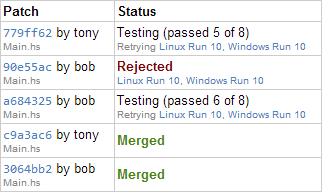
To give a flavour, the web GUI looks of a running Bake system looks like:

The Design

Bake is a Haskell library that can be used to put together a continuous integration server. To run Bake you start a single server for your project, which coordinates tasks, provides an HTTP API for submitting new patches, and a web-based GUI for viewing the progress of your patches. You also run some Bake clients which run the tests on behalf of the server. While Bake is written in Haskell, most of the tests are expected to just call some system command.

There are a few aspects that make Bake unique:

  • Patches are submitted to Bake, but are not applied to the main repo until they have passed all their tests. There is no way for someone to "break the build" - at all points the repo will build on all platforms and all tests will pass.
  • Bake scales up so that even if you have 5 hours of testing and 50 commits a day it will not require 250 hours of computation per day. In order for Bake to prove that a set of patches pass a test, it does not have to test each patch individually.
  • Bake allows multiple clients to run tests, even if some tests are only able to be run on some clients, allowing both parallelisation and specialisation (testing both Windows and Linux, for example).
  • Bake can detect that tests are no longer valid, for example because they access a server that is no longer running, and report the issue without blaming the submitted patches.

An Example

The test suite provides both an example configuration and commands to drive it. Here we annotate a slightly simplified version of the example, for lists of imports see the original code.

First we define an enumeration for where we want tests to run. Our server is going to require tests on both Windows and Linux before a patch is accepted.

data Platform = Linux | Windows deriving (Show,Read)
platforms = [Linux,Windows]

Next we define the test type. A test is something that must pass before a patch is accepted.

data Action = Compile | Run Int deriving (Show,Read)

Our type is named Action. We have two distinct types of tests, compiling the code, and running the result with a particular argument. Now we need to supply some information about the tests:

allTests = [(p,t) | p <- platforms, t <- Compile : map Run [1,10,0]]

execute :: (Platform,Action) -> TestInfo (Platform,Action)
execute (p,Compile) = matchOS p $ run $ do
    cmd "ghc --make Main.hs"
execute (p,Run i) = require [(p,Compile)] $ matchOS p $ run $ do
    cmd ("." </> "Main") (show i)

We have to declare allTests, then list of all tests that must pass, and execute, which gives information about a test. Note that the test type is (Platform,Action), so a test is a platform (where to run the test) and an Action (what to run). The run function gives an IO action to run, and require specifies dependencies. We use an auxiliary matchOS to detect whether a test is running on the right platform:

#if WINDOWS
myPlatform = Windows
#else
myPlatform = Linux
#endif

matchOS :: Platform -> TestInfo t -> TestInfo t
matchOS p = suitable (return . (==) myPlatform)

We use the suitable function to declare whether a test can run on a particular client. Finally, we define the main function:

main :: IO ()
main = bake $
    ovenGit "http://example.com/myrepo.git" "master" $
    ovenTest readShowStringy (return allTests) execute
    defaultOven{ovenServer=("127.0.0.1",5000)}

We define main = bake, then fill in some configuration. We first declare we are working with Git, and give a repo name and branch name. Next we declare what the tests are, passing the information about the tests. Finally we give a host/port for the server, which we can visit in a web browser or access via the HTTP API.

Using the Example

Now we have defined the example, we need to start up some servers and clients using the command line for our tool. Assuming we compiled as bake, we can write bake server and bake client (we'll need to launch at least one client per OS). We can view the state by visiting http://127.0.0.1:5000 in a web browser.

To add a patch we can run bake addpatch --name=cb3c2a71, using the SHA1 of the commit, which will try and integrate that patch into the master branch, after all the tests have passed.

Sunday, October 05, 2014

How to Rewrite the Prelude

Summary: Rewriting the Prelude should be done in a separate package and take a few years to complete, hopefully building a consensus and improving the result.

My recent suggestion that the Prelude shouldn't be rewritten to incorporate Foldable/Traversable generated a lot of feedback. It's clear some people strongly agree, and some strongly disagree. So instead of continuing the argument, in this post I'm going to describe how I think the people who want to change the Prelude should go about it.

There were a lot of comments that we should optimise Haskell for practitioners, not beginners - in particular that there should be Prelude (for advanced users) and Prelude.Simple (for beginners). My personal opinion is that if we have two Prelude's, why not make the beginner one the default one? Switching to the non-default one probably takes one line of moderately advanced syntax (currently import Prelude(); import Prelude.Advanced). For a beginner, writing a simple one line program, that more than doubles the complexity. For a moderate user, that's almost certainly outweighed by lines of LANGUAGE pragmas. (I'm also not sure that I want the "Advanced" Prelude, but that's not relevant to this post.)

Step 1: Write the new Prelude in a package

The first step to proposing a new Prelude should be to write Prelude.Advanced in a separate package on Hackage. Let's assume we have a package base-advanced with a module Prelude.Advanced. The Prelude is not trivial, and translating high-level design goals (e.g. move Foldable into the Prelude) requires some design choices to translate into concrete code.

Step 2: Gain users and feedback

Rather than roll out the Prelude to everyone at once, slowly try and persuade people that your Prelude is superior to the existing one. In doing so, advanced users can start trying out the Prelude, and describing their experiences with it. Does it require Foldable to gain a size method? Does it show up a GHC error message that could be better? Do we need some new type of defaulting? Does profiling give poor results without some manually inserted cost centre? Is a direct list isomorphism a better type class to start from (as F# does with IEnumerable)? Given the number of enthusiastic supporters, this step should be easy.

Step 3: Incorporate feedback

The feedback from step 2 needs incorporating into the package, and potentially into GHC itself. I expect that will result in a significant number of revisions, and perhaps significant departures from the original design. Note that the classy-prelude package is following the steps above, and has had 38 revisions on Hackage so far.

Step 4: Gain acceptance

Before going any further, some critical mass of people need to agree the new way is preferable. There may turn out to be competing proposals, and hopefully as a community we can find consensus and identify the best ideas (as we are currently doing with IO streaming libraries).

Step 5: Move to base

Once we have agreement on what the new Prelude should look like, it should probably be moved into base. At this point, based on all the experience we've got, we can decide whether it becomes Prelude or Prelude.Advanced. At the same time as moving into base, we should decide on the simpler story, but what that decision looks like, will depend on what the proposed Prelude looks like.

The current approach

There are a number of areas that current approach worry me. The change was made directly in the base Prelude, based on some agreement of high-level design decisions, and has already resulted in unexpected additions to the Foldable class. The Prelude will first be exposed to lots of users once GHC 7.10 ships, by which point iterating on feedback will be slow and difficult. The plan for the "beginner" version is to encourage beginners to use the haskell2010 package, which I don't think has been thought out (as someone who tried to use the haskell98 package for a short while, the exception change meant you couldn't use haskell98 and base in the same package, which is basically fatal).

The Haskell community changed Applicative to be a superclass of Monad. That change was simple and thoroughly thought out over a period of years. Warnings were added to GHC, packages were analysed, people experimented with what it would mean, and once decided the change took a number of GHC releases to fully roll out. I consider this change to have been done the right way. In contrast, the complete rewrite of the Prelude is happening far more quickly, and I would argue too quickly. By taking a bit more time hopefully we can come up with something even better.