Showing posts with label bake. Show all posts

Sunday, May 13, 2018

The end of Bake

Summary: I no longer develop Bake, my continuous integration tool.

In 2014 I started a new project of a continuous integration system, named Bake. The selling point of Bake was that it provided always-correct master development, but didn't require running all tests on all patches, allowing the development to scale much faster than the test resources. Over time I refined the model and figured out exactly how to optimise throughput. The experiments were promising, but I'm no longer working on Bake, because:

  • I wrote Bake with an eye to a particular set of challenges for my employer. I then changed jobs, and the challenges have changed. I don't have a strong need for Bake, and I don't think a project like Bake can be successful without dogfooding.
  • I have plenty of other projects that are fighting for my attention. While I think Bake is cool, it's certainly at the early stages, I think it needs a lot of work to have any meaningful impact.
  • Bake has a clever algorithm (I <3 algorithms!), and now needs a ton of evangalism, polish and web UI work (I was a webdev in a previous life, but it's not something I want to spend my spare time on).
  • The problem space that Bake targets is a bit weird. Open-source projects with a small contributor base (less than 5 people full time) are well served by Travis/Appveyor etc, which I happily use for all my open-source projects. Big tech companies (e.g. Google and Facebook) can aford to throw hardware at the problem and have custom solutions. That leaves Bake with the niche of 5-500 commerical programmer teams, which isn't such a natural fit for open-source software.

What I didn't find is any design flaw in the approach. I still think the ideas behind Bake are valuable, so would love to see them go somewhere, but leave it to others. The code remains on GitHub with a stack.yaml and shell.nix that should (in theory) let people play with it indefinitely, but I won't be accepting any patches - other than to point at forks.

Monday, August 10, 2015

Upcoming talk to the Cambridge UK Meetup, Thursday 13 Aug (Shake 'n' Bake)

I'll be talking at the Cambridge NonDysFunctional Programmers Meetup this coming Thursday (13 Aug 2015). Doors open at 7:00pm with talk 7:30-8:30pm, followed by beer/food. I'll be talking about Shake 'n' Bake. The abstract is:

Shake is a Haskell build system, an alternative to Make, but with more powerful and accurate dependencies. I'll cover how to build things with Shake, and why I laugh at non-Monadic build systems (which covers most things that aren't Shake). Shake is an industrial quality library, with a website at http://shakebuild.com.

Bake is a Haskell continuous integration system, an alternative to Travis/Jenkins, but designed for large semi-trusted teams. Bake guarantees that all code arriving in your master branch passes all tests on all platforms, while using as few resources as possible, allowing you to have hours of tests, 100's of commits a day and one a few lonely test servers. Bake is held together with duct tape.

I look forward to seeing people there.

Friday, June 19, 2015

Maximum Patches, Minimum Time

Summary: Writing a fast continuous integration server is tricky.

When I started writing the continuous integration server Bake, I thought I had a good idea of what would go fast. It turned out I was wrong. The problem Bake is trying to solve is:

  • You have a set of tests that must pass, which take several hours to run.
  • You have a current state of the world, which passes all the tests.
  • You have a stream of hundreds of incoming patches per day that can be applied to the current state.
  • You want to advance the state by applying patches, ensuring the current state always passes all tests.
  • You want to reject bad patches and apply good patches as fast as possible.

I assume that tests can express dependencies, such as you must compile before running any tests. The test that performs compilation is special because it can go much faster if only a few things have changed, benefiting from incremental compilation.

Both my wrong solution, and my subsequent better solution, are based on the idea of a candidate - a sequence of patches applied to the current state that is the focus of testing. The solutions differ in when patches are added/removed from the candidate and how the candidates are compiled.

A Wrong Solution

My initial solution compiled and ran each candidate in a separate directory. When the directory was first created, it copied a nearby candidate to try and benefit from incremental compilation.

Each incoming patch was immediately included in the candidate, compiled, and run on all tests. I would always run the test that had not passed for the longest time, to increase confidence in more patches. Concretely, if I have run test T1 on patch P1, and P2 comes in, I start testing T2 on the combination of P1+P2. After that passes I can be somewhat confident that P1 passes both T1 and T2, despite not having run T2 on just P1.

If a test fails, I bisect to find the patch that broke it, reject the patch, and immediately throw it out of the candidate.

The Problems

There are three main problems with this approach:

  • Every compilation starts with a copy of a nearby candidate. Copying a directory of lots of small files (the typical output of a compiler) is fantastically expensive on Windows.
  • When bisecting, I have to compile at lots of prefixes of the candidate, the cost of which varies significantly based on the directory it starts from.
  • I'm regularly throwing patches out of the candidate, which requires a significant amount of compilation, as it has to recompile all patches that were after the rejected patch.
  • I'm regularly adding patches to the candidate, each of which requires an incremental compilation, but tends to be dominated by the directory copy.

This solution spent all the time copying and compiling, and relatively little time testing.

A Better Solution

To benefit from incremental compilation and avoid copying costs, I always compile in the same directory. Given a candidate, I compile each patch in the series one after another, and after each compilation I zip up the interesting files (the test executables and test data). To bisect, I unzip the relevant files to a different directory. On Windows, unzipping is much more expensive than zipping, but that only needs to be done when bisecting is required. I also only need to zip the stuff required for testing, not for building, which is often much smaller.

When testing a candidate, I run all tests without extending the candidate. If all the tests pass I update the state and create a new candidate containing all the new patches.

If any test fails I bisect to figure out who should be rejected, but don't reject until I've completed all tests. After identifying all failing tests, and the patch that caused each of them to fail, I throw those patches out of the candidate. I then rebuild with the revised candidate and run only those tests that failed last time around, trying to seek out tests where two patches in a candidate both broke them. I keep repeating with only the tests that failed last time, until no tests fail. Once there are no failing tests, I extend the candidate with all new patches, but do not update the state.

As a small tweak, if there are two patches in the queue from the same person, where one is a superset of the other, I ignore the subset. The idea is that if the base commit has an error I don't want to track it down twice, once to the first failing commit and then again to the second one.

Using this approach in Bake

First, the standard disclaimer: Bake may not meet your needs - it is a lot less developed than other continuous integration systems. If you do decide to use Bake, you should run from the git repo, as the Hackage release is far behind. That said, Bake is now in a reasonable shape, and might be suitable for early adopters.

In Bake this approach is implemented in the StepGit module, with the ovenStepGit function. Since Bake doesn't have the notion of building patches in series it pretends (to the rest of Bake) that it's building the final result, but secretly caches the intermediate steps. If there is a failure when compiling, it caches that failure, and reports it to each step in the bisection, so Bake tracks down the correct root cause.

I am currently recommending ovenStepGit as the "best" approach for combining git and an incremental build system with Bake. While any incremental build system works, I can't help but plug Shake, because its the best build system I've ever written.

Thursday, March 26, 2015

New website with new talks

My website is now located at ndmitchell.com and has a few new talks on it:

My old website at community.haskell.org is going to stop being updated, and I'll be putting in redirections shortly. That server is going to stop hosting websites, so I bought myself a domain name and setup a GitHub pages website. The repo is here, including all the data, metadata, templates and scripts.

Sunday, November 02, 2014

November talks

Summary: I'll be talking at CodeMesh 2014 on 5th November and FP Days on 20th November.

I am giving two talks in London this month:

CodeMesh 2014 - Gluing Things Together with Haskell, 5th Nov

I'll be talking about how you can use Haskell as the glue language in a project, instead of something like Bash. In particular, I'll cover Shake, NSIS and Bake. The abstract reads:

A large software project is more than just the code that goes into a release, in particular you need lots of glue code to put everything together - including build systems, test harnesses, installer generators etc. While the choice of language for the project is often a carefully considered decision, more often than not the glue code consists of shell scripts and Makefiles. But just as functional programming provides a better way to write the project, it also provides a better way to write the glue code. This talk covers some of the technologies and approaches we use at Standard Chartered to glue together the quant library. In particular, we'll focus on the build system where we replaced 10,000 lines of Makefiles with 1,000 lines of Haskell which builds the project twice as fast. We'll also look at how to test programs using Haskell, how to replace ancillary shell scripts with Haskell, and how to use Haskell to generate installers.

FP Days 2014 - Building stuff with Shake, 20th Nov

I'll be giving a tutorial on building stuff with Shake. It's going to be less sales pitch, more how you structure a build system, and how you use Shake effectively. The abstract reads:

Build systems are a key part of any large software project, relied upon by both developers and release processes. It's important that the build system is understandable, reliable and fast. This talk introduces the Shake build system which is intended to help meet those goals. Users of Shake write a Haskell program which makes heavy use of the Shake library, while still allowing the full power of Haskell to be used. The Shake library provides powerful dependency features along with useful extras (profiling, debugging, command line handling). This tutorial aims to help you learn how to think about writing build systems, and how to make those thoughts concrete in Shake.

Tuesday, October 07, 2014

Bake - Continuous Integration System

Summary: I've written a continuous integration system, in Haskell, designed for large projects. It works, but probably won't scale yet.

I've just released bake, a continuous integration system - an alternative to Jenkins, Travis, Buildbot etc. Bake eliminates the problem of "broken builds", a patch is never merged into the repo before it has passed all the tests.

Bake is designed for large, productive, semi-trusted teams:

  • Large teams where there are at least several contributors working full-time on a single code base.
  • Productive teams which are regularly pushing code, many times a day.
  • Semi-trusted teams where code does not go through manual code review, but code does need to pass a test suite and perhaps some static analysis. People are assumed to be fallible.

Current state: At the moment I have a rudimentary test suite, and it seems to mostly work, but Bake has never been deployed for real. Some optional functionality doesn't work, some of the web UI is a bit crude, the algorithms probably don't scale and all console output from all tests is kept in memory forever. I consider the design and API to be complete, and the scaling issues to be easily fixable - but it's easier to fix after it becomes clear where the bottleneck is. If you are interested, take a look, and then email me.

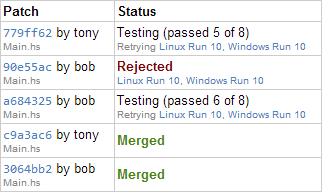
To give a flavour, the web GUI looks of a running Bake system looks like:
The Design

Bake is a Haskell library that can be used to put together a continuous integration server. To run Bake you start a single server for your project, which coordinates tasks, provides an HTTP API for submitting new patches, and a web-based GUI for viewing the progress of your patches. You also run some Bake clients which run the tests on behalf of the server. While Bake is written in Haskell, most of the tests are expected to just call some system command.

There are a few aspects that make Bake unique:

  • Patches are submitted to Bake, but are not applied to the main repo until they have passed all their tests. There is no way for someone to "break the build" - at all points the repo will build on all platforms and all tests will pass.
  • Bake scales up so that even if you have 5 hours of testing and 50 commits a day it will not require 250 hours of computation per day. In order for Bake to prove that a set of patches pass a test, it does not have to test each patch individually.
  • Bake allows multiple clients to run tests, even if some tests are only able to be run on some clients, allowing both parallelisation and specialisation (testing both Windows and Linux, for example).
  • Bake can detect that tests are no longer valid, for example because they access a server that is no longer running, and report the issue without blaming the submitted patches.

An Example

The test suite provides both an example configuration and commands to drive it. Here we annotate a slightly simplified version of the example, for lists of imports see the original code.

First we define an enumeration for where we want tests to run. Our server is going to require tests on both Windows and Linux before a patch is accepted.

data Platform = Linux | Windows deriving (Show,Read)
platforms = [Linux,Windows]

Next we define the test type. A test is something that must pass before a patch is accepted.

data Action = Compile | Run Int deriving (Show,Read)

Our type is named Action. We have two distinct types of tests, compiling the code, and running the result with a particular argument. Now we need to supply some information about the tests:

allTests = [(p,t) | p <- platforms, t <- Compile : map Run [1,10,0]]

execute :: (Platform,Action) -> TestInfo (Platform,Action)
execute (p,Compile) = matchOS p $ run $ do
    cmd "ghc --make Main.hs"
execute (p,Run i) = require [(p,Compile)] $ matchOS p $ run $ do
    cmd ("." </> "Main") (show i)

We have to declare allTests, then list of all tests that must pass, and execute, which gives information about a test. Note that the test type is (Platform,Action), so a test is a platform (where to run the test) and an Action (what to run). The run function gives an IO action to run, and require specifies dependencies. We use an auxiliary matchOS to detect whether a test is running on the right platform:

#if WINDOWS
myPlatform = Windows
#else
myPlatform = Linux
#endif

matchOS :: Platform -> TestInfo t -> TestInfo t
matchOS p = suitable (return . (==) myPlatform)

We use the suitable function to declare whether a test can run on a particular client. Finally, we define the main function:

main :: IO ()
main = bake $
    ovenGit "http://example.com/myrepo.git" "master" $
    ovenTest readShowStringy (return allTests) execute
    defaultOven{ovenServer=("127.0.0.1",5000)}

We define main = bake, then fill in some configuration. We first declare we are working with Git, and give a repo name and branch name. Next we declare what the tests are, passing the information about the tests. Finally we give a host/port for the server, which we can visit in a web browser or access via the HTTP API.

Using the Example

Now we have defined the example, we need to start up some servers and clients using the command line for our tool. Assuming we compiled as bake, we can write bake server and bake client (we'll need to launch at least one client per OS). We can view the state by visiting http://127.0.0.1:5000 in a web browser.

To add a patch we can run bake addpatch --name=cb3c2a71, using the SHA1 of the commit, which will try and integrate that patch into the master branch, after all the tests have passed.