Monday, October 13, 2014

Shake's Internal State

Summary: Shake is not like Make, it has different internal state, which leads to different behaviour. I also store the state in an optimised way.

Update: I'm keeping an up to date version of this post in the Shake repo, which includes a number of questions/answers at the bottom, and is likely to evolve over time to incorporate that information into the main text.

In order to understand the behaviour of Shake, it is useful to have a mental model of Shake's internal state. To be a little more concrete, let's talk about Files which are stored on disk, which have ModTime value's associated with them, where modtime gives the ModTime of a FilePath (Shake is actually generalised over all those things). Let's also imagine we have the rule:

file *> \out -> do
    need [dependency]
    run

So file depends on dependency and rebuilds by executing the action run.

The Make Model

In Make there is no additional state, only the file-system. A file is considered dirty if it has a dependency such that:

modtime dependency > modtime file

As a consequence, run must update modtime file, or the file will remain dirty and rebuild in subsequent runs.

The Shake Model

For Shake, the state is:

database :: File -> (ModTime, [(File, ModTime)])

Each File is associated with a pair containing the ModTime of that file, plus a list of each dependency and their modtimes, all from when the rule was last run. As part of executing the rule above, Shake records the association:

file -> (modtime file, [(dependency, modtime dependency)])

The file is considered dirty if any of the information is no longer current. In this example, if either modtime file changes, or modtime dependency changes.

There are a few consequences of the Shake model:

  • There is no requirement for modtime file to change as a result of run. The file is dirty because something changed, after we run the rule and record new information it becomes clean.
  • Since a file is not required to change its modtime, things that depend on file may not require rebuilding even if file rebuilds.
  • If you update an output file, it will rebuild that file, as the ModTime of a result is tracked.
  • Shake only ever performs equality tests on ModTime, never ordering, which means it generalises to other types of value and works even if your file-system sometimes has incorrect times.

These consequences allow two workflows that aren't pleasant in Make:

  • Generated files, where the generator changes often, but the output of the generator for a given input changes rarely. In Shake, you can rerun the generator regularly, and using a function that writes only on change (writeFileChanged in Shake) you don't rebuild further. This technique can reduce some rebuilds from hours to seconds.
  • Configuration file splitting, where you have a configuration file with lots of key/value pairs, and want certain rules to only depend on a subset of the keys. In Shake, you can generate a file for each key/value and depend only on that key. If the configuration file updates, but only a subset of keys change, then only a subset of rules will rebuild. Alternatively, using Development.Shake.Config you can avoid the file for each key, but the dependency model is the same.

Optimising the Model

The above model expresses the semantics of Shake, but the implementation uses an optimised model. Note that the original Shake paper gives the optimised model, not the easy to understand model - that's because I only figured out the difference a few days ago (thanks to Simon Marlow, Simon Peyton Jones and Andrey Mokhov). To recap, we started with:

database :: File -> (ModTime, [(File, ModTime)])

We said that File is dirty if any of the ModTime values change. That's true, but what we are really doing is comparing the first ModTime with the ModTime on disk, and the list of second ModTime's with those in database. Assuming we are passed the current ModTime on disk, then a file is valid if:

valid :: File -> ModTime -> Bool
valid file mNow =
    mNow == mOld &&
    and [fst (database d) == m | (d,m) <- deps]
    where (mOld, deps) = database file

The problem with this model is that we store each File/ModTime pair once for the file itself, plus once for every dependency. That's a fairly large amount of information, and in Shake both File and ModTime can be arbitrarily large for user rules.

Let's introduce two assumptions:

Assumption 1: A File only has at most one ModTime per Shake run, since a file will only rebuild at most once per run. We use Step for the number of times Shake has run on this project.

Consequence 1: The ModTime for a file and the ModTime for its dependencies are all recorded in the same run, so they share the same Step.

Assumption 2: We assume that if the ModTime of a File changes, and then changes back to a previous value, we can still treat that as dirty. In the specific case of ModTime that would require time travel, but even for other values it is very rare.

Consequence 2: We only use historical ModTime values to compare them for equality with current ModTime values. We can instead record the Step at which the ModTime last changed, assuming all older Step values are unequal.

The result is:

database :: File -> (ModTime, Step, Step, [File])

valid :: File -> ModTime -> Bool
valid file mNow =
    mNow == mOld &&
    and [sBuild >= changed (database d) | d <- deps]
    where (mOld, sBuilt, sChanged, deps) = database file
          changed (_, _, sChanged, _) = sChanged

For each File we store its most recently recorded ModTime, the Step at which it was built, the Step when the ModTime last changed, and the list of dependencies. We now check if the Step for this file is greater than the Step at which dependency last changed. Using the assumptions above, the original formulation is equivalent.

Note that instead of storing one ModTime per dependency+1, we now store exactly one ModTime plus two small Step values.

We still store each file many times, but we reduce that by creating a bijection between File (arbitrarily large) and Id (small index) and only storing Id.

Implementing the Model

For those who like concrete details, which might change at any point in the future, the relevant definition is in Development.Shake.Database:

data Result = Result
    {result    :: Value   -- the result when last built
    ,built     :: Step    -- when it was actually run
    ,changed   :: Step    -- when the result last changed
    ,depends   :: [[Id]]  -- dependencies
    ,execution :: Float   -- duration of last run
    ,traces    :: [Trace] -- a trace of the expensive operations
    } deriving Show

The differences from the model are:

  • ModTime became Value, because Shake deals with lots of types of rules.
  • The dependencies are stored as a list of lists, so we still have access to the parallelism provided by need, and if we start rebuilding some dependencies we can do so in parallel.
  • We store execution and traces so we can produce profiling reports.
  • I haven't shown the File/Id mapping here - that lives elsewhere.
  • I removed all strictness/UNPACK annotations from the definition above, and edited a few comments.

As we can see, the code follows the optimised model quite closely.

Tuesday, October 07, 2014

Bake - Continuous Integration System

Summary: I've written a continuous integration system, in Haskell, designed for large projects. It works, but probably won't scale yet.

I've just released bake, a continuous integration system - an alternative to Jenkins, Travis, Buildbot etc. Bake eliminates the problem of "broken builds", a patch is never merged into the repo before it has passed all the tests.

Bake is designed for large, productive, semi-trusted teams:

  • Large teams where there are at least several contributors working full-time on a single code base.
  • Productive teams which are regularly pushing code, many times a day.
  • Semi-trusted teams where code does not go through manual code review, but code does need to pass a test suite and perhaps some static analysis. People are assumed to be fallible.

Current state: At the moment I have a rudimentary test suite, and it seems to mostly work, but Bake has never been deployed for real. Some optional functionality doesn't work, some of the web UI is a bit crude, the algorithms probably don't scale and all console output from all tests is kept in memory forever. I consider the design and API to be complete, and the scaling issues to be easily fixable - but it's easier to fix after it becomes clear where the bottleneck is. If you are interested, take a look, and then email me.

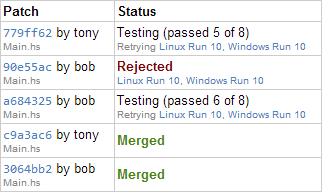
To give a flavour, the web GUI looks of a running Bake system looks like:

The Design

Bake is a Haskell library that can be used to put together a continuous integration server. To run Bake you start a single server for your project, which coordinates tasks, provides an HTTP API for submitting new patches, and a web-based GUI for viewing the progress of your patches. You also run some Bake clients which run the tests on behalf of the server. While Bake is written in Haskell, most of the tests are expected to just call some system command.

There are a few aspects that make Bake unique:

  • Patches are submitted to Bake, but are not applied to the main repo until they have passed all their tests. There is no way for someone to "break the build" - at all points the repo will build on all platforms and all tests will pass.
  • Bake scales up so that even if you have 5 hours of testing and 50 commits a day it will not require 250 hours of computation per day. In order for Bake to prove that a set of patches pass a test, it does not have to test each patch individually.
  • Bake allows multiple clients to run tests, even if some tests are only able to be run on some clients, allowing both parallelisation and specialisation (testing both Windows and Linux, for example).
  • Bake can detect that tests are no longer valid, for example because they access a server that is no longer running, and report the issue without blaming the submitted patches.

An Example

The test suite provides both an example configuration and commands to drive it. Here we annotate a slightly simplified version of the example, for lists of imports see the original code.

First we define an enumeration for where we want tests to run. Our server is going to require tests on both Windows and Linux before a patch is accepted.

data Platform = Linux | Windows deriving (Show,Read)
platforms = [Linux,Windows]

Next we define the test type. A test is something that must pass before a patch is accepted.

data Action = Compile | Run Int deriving (Show,Read)

Our type is named Action. We have two distinct types of tests, compiling the code, and running the result with a particular argument. Now we need to supply some information about the tests:

allTests = [(p,t) | p <- platforms, t <- Compile : map Run [1,10,0]]

execute :: (Platform,Action) -> TestInfo (Platform,Action)
execute (p,Compile) = matchOS p $ run $ do
    cmd "ghc --make Main.hs"
execute (p,Run i) = require [(p,Compile)] $ matchOS p $ run $ do
    cmd ("." </> "Main") (show i)

We have to declare allTests, then list of all tests that must pass, and execute, which gives information about a test. Note that the test type is (Platform,Action), so a test is a platform (where to run the test) and an Action (what to run). The run function gives an IO action to run, and require specifies dependencies. We use an auxiliary matchOS to detect whether a test is running on the right platform:

#if WINDOWS
myPlatform = Windows
#else
myPlatform = Linux
#endif

matchOS :: Platform -> TestInfo t -> TestInfo t
matchOS p = suitable (return . (==) myPlatform)

We use the suitable function to declare whether a test can run on a particular client. Finally, we define the main function:

main :: IO ()
main = bake $
    ovenGit "http://example.com/myrepo.git" "master" $
    ovenTest readShowStringy (return allTests) execute
    defaultOven{ovenServer=("127.0.0.1",5000)}

We define main = bake, then fill in some configuration. We first declare we are working with Git, and give a repo name and branch name. Next we declare what the tests are, passing the information about the tests. Finally we give a host/port for the server, which we can visit in a web browser or access via the HTTP API.

Using the Example

Now we have defined the example, we need to start up some servers and clients using the command line for our tool. Assuming we compiled as bake, we can write bake server and bake client (we'll need to launch at least one client per OS). We can view the state by visiting http://127.0.0.1:5000 in a web browser.

To add a patch we can run bake addpatch --name=cb3c2a71, using the SHA1 of the commit, which will try and integrate that patch into the master branch, after all the tests have passed.

Sunday, October 05, 2014

How to Rewrite the Prelude

Summary: Rewriting the Prelude should be done in a separate package and take a few years to complete, hopefully building a consensus and improving the result.

My recent suggestion that the Prelude shouldn't be rewritten to incorporate Foldable/Traversable generated a lot of feedback. It's clear some people strongly agree, and some strongly disagree. So instead of continuing the argument, in this post I'm going to describe how I think the people who want to change the Prelude should go about it.

There were a lot of comments that we should optimise Haskell for practitioners, not beginners - in particular that there should be Prelude (for advanced users) and Prelude.Simple (for beginners). My personal opinion is that if we have two Prelude's, why not make the beginner one the default one? Switching to the non-default one probably takes one line of moderately advanced syntax (currently import Prelude(); import Prelude.Advanced). For a beginner, writing a simple one line program, that more than doubles the complexity. For a moderate user, that's almost certainly outweighed by lines of LANGUAGE pragmas. (I'm also not sure that I want the "Advanced" Prelude, but that's not relevant to this post.)

Step 1: Write the new Prelude in a package

The first step to proposing a new Prelude should be to write Prelude.Advanced in a separate package on Hackage. Let's assume we have a package base-advanced with a module Prelude.Advanced. The Prelude is not trivial, and translating high-level design goals (e.g. move Foldable into the Prelude) requires some design choices to translate into concrete code.

Step 2: Gain users and feedback

Rather than roll out the Prelude to everyone at once, slowly try and persuade people that your Prelude is superior to the existing one. In doing so, advanced users can start trying out the Prelude, and describing their experiences with it. Does it require Foldable to gain a size method? Does it show up a GHC error message that could be better? Do we need some new type of defaulting? Does profiling give poor results without some manually inserted cost centre? Is a direct list isomorphism a better type class to start from (as F# does with IEnumerable)? Given the number of enthusiastic supporters, this step should be easy.

Step 3: Incorporate feedback

The feedback from step 2 needs incorporating into the package, and potentially into GHC itself. I expect that will result in a significant number of revisions, and perhaps significant departures from the original design. Note that the classy-prelude package is following the steps above, and has had 38 revisions on Hackage so far.

Step 4: Gain acceptance

Before going any further, some critical mass of people need to agree the new way is preferable. There may turn out to be competing proposals, and hopefully as a community we can find consensus and identify the best ideas (as we are currently doing with IO streaming libraries).

Step 5: Move to base

Once we have agreement on what the new Prelude should look like, it should probably be moved into base. At this point, based on all the experience we've got, we can decide whether it becomes Prelude or Prelude.Advanced. At the same time as moving into base, we should decide on the simpler story, but what that decision looks like, will depend on what the proposed Prelude looks like.

The current approach

There are a number of areas that current approach worry me. The change was made directly in the base Prelude, based on some agreement of high-level design decisions, and has already resulted in unexpected additions to the Foldable class. The Prelude will first be exposed to lots of users once GHC 7.10 ships, by which point iterating on feedback will be slow and difficult. The plan for the "beginner" version is to encourage beginners to use the haskell2010 package, which I don't think has been thought out (as someone who tried to use the haskell98 package for a short while, the exception change meant you couldn't use haskell98 and base in the same package, which is basically fatal).

The Haskell community changed Applicative to be a superclass of Monad. That change was simple and thoroughly thought out over a period of years. Warnings were added to GHC, packages were analysed, people experimented with what it would mean, and once decided the change took a number of GHC releases to fully roll out. I consider this change to have been done the right way. In contrast, the complete rewrite of the Prelude is happening far more quickly, and I would argue too quickly. By taking a bit more time hopefully we can come up with something even better.

Wednesday, October 01, 2014

Why Traversable/Foldable should not be in the Prelude

Summary: For GHC 7.10, Traversable and Foldable are going to be in the Prelude. I missed the original discussion, but I suspect it's a bad idea.

Types are how Haskell programmers communicate their intentions to each other. Currently, the Haskell Prelude contains:

mapM :: Monad m => (a -> m b) -> [a] -> m [b]

As of GHC 7.10, as part of something known as the Burning Bridges Proposal (ticket, discussion, I can't actually find a full proposal...), that will become:

mapM :: (Traversable t, Monad m) => (a -> m b) -> t a -> m (t b)

Surely that's a good thing? Aren't more general types always better? Isn't the Prelude an archaic beast from the time before? I'd argue functions which are highly polymorphic are hard to use, and hard to think about, especially for beginners. I'd also argue the Prelude is remarkably well designed, not perfect, but quite an impressive feat.

What makes a type signature complex?

I've been thinking recently about what makes type signatures complex, both to practitioners, and to relative beginners. My rough metric is:

  • Fully concrete types are usually simple, as long as they aren't too long. The longer a type gets, the more complex it gets.
  • Types with functions in them aren't too bad (order-1 types), but as you go up to order-2 types things start to get more complex.
  • Fully polymorphic functions can be simpler than concrete functions, since they declare what you don't need to worry about.
  • Functions with type classes are more complex, since you need to read the type signature while looking at the context, and need to know each class being used.
  • Simple type classes (Eq, Show) aren't too bad, but custom type classes impose more of a burden.
  • As you add more type classes, the complexity grows faster than linearly. Three type classes are not three times as complex as one, but quite a bit harder.
  • Higher kinded type classes are significantly more complex than kind * type classes, e.g. Monad, Functor. The reason is that instead of having a hole you fill in, you now have a hole which itself has a hole.
  • The higher-kinded type classes Monad and Functor aren't as bad as the others, since Functor is really the "simplest" higher-kinded type class, and Monad is required knowledge for IO.
  • As you have more higher kinded type classes, the complexity burden grows even worse than for kind * type classes. Two is significantly more complex than one.

By that metric, the old mapM isn't too bad, but the new mapM is quite complex. It has two higher-kinded type classes, and one of them is not one of the common ones. I appreciate that making Foldable and Traversable key to Haskell will probably lead to them being more used, but now all beginners are going to have to wade through the Monad tutorial, their Foldable tutorial and their Traversable tutorial before they start programming (or just give up).

Why generality hurts

There are two main reasons why generality hurts:

Reading type signatures becomes difficult/impossible. We already have that problem with the Control.Arrow module, which (as far as most people use it), is just a pile of tuple combinators. But unlike other tuple combinators, these are ones whose type signature can't be understood. When I want to use &&& or *** I just pick randomly, see if it type checks, then try again. When other people I know what to use these functions they just use an explicit lambda. No one thinks of referring to the documentation, since the documentation presents a unification problem (which most of the people I know could solve), not an intuition.

Reading code becomes difficult. Haskell is brilliant for letting you write a composable pipeline of code that takes some input, does some processing, and produces some output. But that only works if you have enough concrete pieces in each function to read each piece in isolation. As an example:

test = foo . mapM baz . bar

Using the current mapM definition I can, in a fraction of a second, know the approximate shape of what foo consumes, and what bar produces. With the new mapM I don't, and have to keep more context in my head to reason about the code.

Who it hurts

Generality of this nature tends to hurt two types of people:

Beginners are hurt because they need to know more concepts just to get going. As a beginner I read through Data.List regularly to build up weapons in my arsenal to attack larger problems. The new Data.List will be generalised, and reading it won't give the insights I enjoyed. Maybe the beginner can instantiate all Foldable things to [], but that adds a mental burden to exactly those people who can bear it least.

Practitioners, those who are paid to code for a living, will have greater problems with maintenance. This isn't an unsubstantiated guess... I have taken over a project which made extensive use of the generalised traverse and sequence functions. Yes, the code was concise, but it was read-only, and even then, required me to "trust" that the compiler and libraries snapped together properly.

Who it benefits

The benefit probably comes from those who are already using the Applicative/Traversable classes regularly. For these people, they can probably avoid an import Prelude(). I am not against ever changing the Prelude, but I do think that for changes of this magnitude the ideas should probably be prototyped as a separate package, widely accepted, and only then should significant surgery be attempted on the Prelude. The classy-prelude work has gone in that direction, and I wish them luck, but the significant changes they've already iterated through suggest the design space is quite large.

Concluding remarks

I realise that I got to this discussion late, perhaps too late to expect my viewpoint to count. But I'd like to leave by reproducing Henning Thielemann's email on the subject:

David Luposchainsky wrote:

+1. I think the Prelude should be a general module of the most commonly
needed functions, which (generalized) folds and traversals are certainly
part of; right now it feels more like a beginner module at times.

It is certainly a kind of beginner module, but that's good. Experts know
how to import. Putting the most general functions into Prelude does not
work because:

1. There are often multiple sensible generalizations of a Prelude
function.

2. You have to add more type annotations since types cannot be infered
from the functions.

There is simply no need to change Prelude and all packages that rely on
specific types. Just don't be lazy and import the stuff you need!

I should change my vote to:

-10

Saturday, September 27, 2014

GHCID - a new GHCi based IDE (ish)

Summary: I've just released ghcid, which interactively shows the errors in your project on each save.

I'm please to announce ghcid, which is either "GHCi as a daemon" or "GHC + a bit of an IDE". I've been using it for my development for the last few days, and already find it quite valuable. Unlike other Haskell development tools, ghcid is intended to be incredibly simple. In particular, it doesn't integrate with any editors, doesn't depend on GHC the library and doesn't start web servers. It's under 200 lines of fairly dull Haskell, which talks over pipes to your existing ghci.

Using it

Run cabal update && cabal install ghcid to install it as normal. Then run ghcid --height=10 "--command=ghci Main.hs". The height is the number of lines you are going to resize your console window to (defaults to 8), and the command is how you start this project in ghci. Personally, I always create a .ghci file at the root of all my projects, which usually reads something like:

:set -fwarn-unused-binds -fwarn-unused-imports
:set -isrc
:load Main

With that you can pass --command=ghci (or nothing, since that is the default).

After that, resize your console and make it so you can see it while working in your editor. On Windows the ghcid console will automatically sit on top of all other windows. On Linux, you probably want to use your window manager to make it topmost or use a tiling window manager.

What you get

On every save you'll see a list of the errors and warnings in your project. It uses a single ghci under the hood, so even relatively large projects should update their status pretty quickly. As an example:

Main.hs:23:10:
    Not in scope: `verbosit'
    Perhaps you meant `verbosity' (imported from System.Console.CmdArgs)
Util.hs:18:1: Warning: Defined but not used: `foo'

Or, if everything is good, you see:

All good

This project is only a few days old, so please report any bugs you find.

What you want

I regularly use an IDE to develop in a Haskell-like language. I find that with the IDE I'm about 25% more productive than without it. While an IDE can provide lots of neat features (go to definition, search, type tooltips) I think most of the productivity gains come from:

  1. Syntax coloring.
  2. A list of errors and warnings...
  3. ...which is updated as you type...
  4. ...and are highlighted in the text (red squiggles).

Every text editor already provides syntax coloring. With ghcid you get the list of errors and warnings. To get the final two features you need to integrate with an editor. I'm hoping that ghcid can do some of the heavy lifting by taking a directory of files to treat as overrides, and producing a list of warnings/errors to a file. The rest is editor specific, and I hope to attempt integration with Sublime Text at some point (although would love some help).

Wednesday, September 24, 2014

Generating Open 3D Viewer Models

Summary: It's not obvious how to generate suitable Open 3D Viewer models, but with the right tools it isn't hard.

The Open 3D Viewer project is very cool, as an example here is a demo of a spinning cow rendered in the browser. For my wife's work I wanted to generate a 3D model of a fossil bedding plane. Effectively, given some x/y/z coordinates, produce a pretty rendering. It took a fair bit of guess work, so I wrote down the steps.

Step 1: Generate an OBJ file

Generate an OBJ file. You probably want an MTL file too, but it seems the 3D viewer only uses the Kd field. There are a few ways to get an OBJ file:

  • There are many samples on the web, including a snail in the Open 3D Viewer repo.
  • You can create OBJ files in a tool such as Blender, but the Blender interface confused me a lot (I am definitely not their intended audience).
  • You can generate an OBJ file using a Haskell script. I picked this method, and I'll write a blog about the script later, once I have some pretty pictures to show.

Step 2: Get the tools

There are some tools in the WebGL Loader project. Alas, that project says "for now I recommend r50 as the last stable revision". So now there are two tools to try, the latest and r50. I tried both. I had some limited success with r50 (it didn't seem to render properly, but it did run) while the latest revision segfaulted. Fortunately I found the tools in a Google Groups post, and have mirrored them in my repo (with trivial tweaks to support Python 2.7).

Step 3: Run objcompress

You need to run:

objcompress mymodel.obj mymodel.utf8 > mymodel.js

This will generate lots of mymodel*.utf8 files and mymodel.js.

Step 3: Run part_grouping.py

You need to run:

py part_grouping.py

(The file in the email is part&grouping.py, but I renamed my copy.) This script will interactively ask a really long list of questions. I generate the correct inputs into a file and pipe it in:

py part_grouping.py < response.txt

This generates the files groupings.txt and part_info.txt.

Step 4: Run make_viewer_metadata.py

Run:

py make_viewer_metadata.py

This generates the file entity_metadata.json.

Step 5: Get the viewer source

You can get the viewer source from the Open 3D Viewer repo. I have mirrored it in my repo, but I may tweak the viewer over time to match my wife's needs - you should get the original.

Step 6: Copy your files

Copy all the files from steps 1 to 4 to a directory inside the viewer named models/mymodel.

Step 7: Update the model list

Open up scripts/models.js and edit it to point at your model. For example:

o3v.MODELS = [{
  name:'mymodel.obj',
  scriptName:'mymodel.js',
  modelPath:'models/mymodel/',
  metadataFile:'entity_metadata.json',
  numLayers:12
}];

Step 8: View the result

You can view the result by opening index.html. In Chrome you may need to pass the flag --allow-file-access-from-files.

Tuesday, September 16, 2014

Towards Shake 1.0

Summary: I've just released a new version of Shake, with a --demo feature and an underlying continuation monad. I want to release v1.0 in the near future.

I've just released a new version of the Shake build system, version 0.13.3. While the version number is only 0.0.1 higher, the changelog lists a large number of improvements. In particular, two changes are:

  • The Action monad is now based on continuations, which allows Shake to suspend threads without requiring a GHC RTS thread. The result is significantly less memory used on thread stacks. I still find it quite amazing that Haskell has such powerful and robust abstraction mechanisms that a huge change doesn't even break the API.
  • The shake binary now features a --demo mode, invoked by running shake --demo. This mode generates a Shake project, compiles it, and shows off some of the features of Shake. You can the output of --demo here.

Version 1.0

With the two features above, I'm now looking towards Shake version 1.0. I'm not looking to make any significant backwards-incompatible change, or necessarily any code/API changes at all. However, if you have anything you think should be addressed before reaching such a milestone, please comment on the issue tracker or email the mailing list.

Shake website

The one thing I still want to finish before releasing version 1.0 is to have a proper website for Shake. I've registered shakebuild.com which will host the content, and have set up GitHub pages to serve it up. I have some rough content in the docs directory and a prototype generator in the website directory - as an example it currently generates something a bit like this for the user manual, but with a table of contents when run through the latest generator. I'd appreciate any help with the content, the generator, or the styling - just email the mailing list.

Sunday, September 07, 2014

Shake in the wild

Summary: I spotted a few things using Shake, which I had nothing to do with.

In the past few days I have come across several things using the Shake build system. I wasn't involved in any of them, and haven't (yet) tried any of them out, but they certainly look cool.

ToolCabal

Tibor Bremer from Utrecht University gave a talk at the Haskell Implementors Workshop 2014 about his ToolCabal project. This project replaces the "build a package" part of Cabal with something more flexible, supporting multiple simultaneous targets and more flexible preprocessors - all built on top of Shake. It doesn't attempt to tackle dependency resolution yet. There is a video of the talk:


Samplecount

The folks at Samplecount have written several Shake based things. None are yet on Hackage, so I suspect they are somewhat prototypes, but they look like they're already used quite seriously.

  • shake-cabal-build to make it easier to build your Shake build systems with Cabal. Shake build systems need to be compiled with GHC, for which I usually use ghc --make, but this project explains how to get things building with Cabal - important if your build system pulls in other libraries.
  • shake-language-c is a project to simplify building C/C++ projects with Shake. From the docs:

shake-language-c is a cross-platform build system based on the Shake Haskell library. The focus is on cross-compilation of C, C++ and Objective C source code to various target platforms. Currently supported target platforms are iOS, Android NDK, Google Portable Native Client, MacOS X, Linux and Windows (MinGW). Supported host platforms are MacOS X, Linux and Windows.

  • methcla is their mobile sound engine, which is built using this Shake script, which (unsurprisingly) uses shake-language-c and shake-cabal-build.

Wednesday, August 20, 2014

Continuations and Exceptions

Summary: In moving Shake to continuations, exceptions were the biggest headache. I figured out how to somewhat integrate continuations and exception handling.

The git repo for Shake now suspends inactive computations by capturing their continuation instead of blocking their thread, based on the continuations I described in a previous blog post. The most difficult part was managing exceptions. I needed to define a monad where I could capture continuations and work with exceptions, requiring the definitions:

data M a = ... deriving (Functor, Applicative, Monad, MonadIO)
throwM :: SomeException -> M a
catchM :: M a -> (SomeException -> M a) -> M a
captureM :: ((a -> IO ()) -> IO ()) -> M a

I'm using M as the name of the monad. I want equivalents of throwIO and catch for M, along with a function to capture continuations.

The first observation is that since catchM must catch any exceptions, including those thrown by users calling error, then throwM can be defined as:

throwM = liftIO . throwIO

Using throwIO gives better guarantees about when the exception is raised, compared to just throw.

The second observation is that sometimes I want to raise an exception on the continuation, rather than passing back a value. I can build that on top of captureM with:

captureM' :: ((Either SomeException a -> IO ()) -> IO ()) -> M a
captureM' k = either throwM return =<< captureM k

The third observation (which I observed after a few weeks trying not to follow it) is that the continuation may never be called, and that means you cannot implement a robust finallyM function. In particular, if the person who was intending to run the continuation themselves raises an exception, the continuation is likely to be lost. I originally tried to come up with schemes for defining the function passed the continuation to guarantee the continuation was called, but it became messy very quickly.

The properties we expect of the implementation, to a rough approximation, include:

  • catchM (x >> throwM e) (\_ -> y) >> z === x >> y >> z -- if you throw an exception inside a catchM, you must run the handler.
  • captureM (\k -> x) >>= y === x -- if you execute something not using the continuation inside captureM it must behave like it does outside captureM. In particular, if the captureM is inside a catchM, that catchM must not catch the exception.
  • captureM (\k -> k x) >>= y === x >>= y -- if you capture the continuation then continue that must be equivalent to not capturing the continuation.
  • captureM (\k -> k x >> k x) >>= y === (x >>= y) >> (x >>= y) -- if you run the continuation twice it must do the same IO actions each time. In particular, if the first gets its exceptions caught, the second must do also.

These properties are incomplete (there are other things you expect), and fuzzy (for example, the second property isn't type correct) - but hopefully they give an intuition.

The implementation was non-trivial and (sadly) non-elegant. I suspect a better implementation is known in the literature, and I'd welcome a pointer. My implementation defines M as:

type M a = ContT () (ReaderT (IORef (SomeException -> IO ())) IO) a

Here we have a continuation monad wrapping a reader monad. The reader contains an IORef which stores the exception handler. The basic idea is that whenever we start running anything in M we call the Haskell catch function, and the exception handler forwards to the IORef. We can define catchM as:

catchM :: M a -> (SomeException -> M a) -> M a
catchM m hdl = ContT $ \k -> ReaderT $ \s -> do
    old <- liftIO $ readIORef s
    writeIORef s $ \e -> do
        s <- newIORef old
        hdl e `runContT` k `runReaderT` s `catch`
            \e -> ($ e) =<< readIORef s
    flip runReaderT s $ m `runContT` \v -> do
        s <- ask
        liftIO $ writeIORef s old
        k v
  • We store the previous exception handler as old, and insert a new one. After the code has finished (we have left the catchM block) we restore the old exception handler. In effect, we have a stack of exception handlers.
  • When running the handler we pop off the current exception handler by restoring old, then since we have already used up our catch, we add a new catch to catch exceptions in the handler.

We then define captureM as:

captureM :: ((a -> IO ()) -> IO ()) -> M a
captureM f = ContT $ \k -> ReaderT $ \s -> do
    old <- readIORef s
    writeIORef s throwIO
    f $ \x -> do
        s <- newIORef old
        flip runReaderT s (k x) `E.catch`
            \e -> ($ e) =<< readIORef s
        writeIORef s throwIO
  • We make sure to switch the IORef back to throwIO before we start running the users code, and after we have finished running our code and switch back to user code. As a result, if the function that captures the continuation throws an exception, it will be raised as normal.
  • When running the continuation we create a new IORef for the handler, since the continuation might be called twice in parallel, and the separate IORef ensures they don't conflict with each other.

Finally, we need a way to run the computation. I've called that runM:

runM :: M a -> (Either SomeException a -> IO ()) -> IO ()
runM m k = do
    let mm = do
            captureM $ \k -> k ()
            catchM (Right <$> m) (return . Left)
    s <- newIORef throwIO
    mm `runContT` (liftIO . k) `runReaderT` s

The signature of runM ends up being the only signature the makes sense given the underlying mechanisms. We define mm by using the facilities of captureM to insert a catch and catchM to ensure we never end up in an exception state from runM. The rest is just matching up the types.

Stack depth could potentially become a problem with this solution. If you regularly do:

captureM (\k -> k ())

Then each time a catch will be wrapped around the function. You can avoid that by changing captureM to throw an exception:

captureM :: ((a -> IO ()) -> IO ()) -> M a
captureM f = ContT $ \k -> ReaderT $ \s -> do
    old <- readIORef s
    writeIORef s $ \_ ->
        f $ \x -> do
            s <- newIORef old
            flip runReaderT s (k x) `E.catch`
                \e -> ($ e) =<< readIORef s
    throwIO anyException

Here we unwind the catch by doing a throwIO, after installing our exception handler which actually passes the continuation. It is a bit ugly, and I haven't checked if either the catch is a problem, or that this solution solves it.

The implementation in Shake is a bit different to that described above. In Shake I know that captured continuations are never called more than once, so I
can avoid creating a new IORef in captureM, and I can reuse the existing one. Since I never change the handler, I can use a slightly less powerful definition of M:

type M a = ReaderT (IORef (SomeException -> IO ())) (ContT () IO) a

The resulting code is Development.Shake.Monad, which implements the RAW monad, and also does a few extra things which are irrelevant to this post.

The cool thing about Haskell is that I've been able to completely replace the underlying Shake Action monad from StateT/IO, to ReaderT/IO, to ReaderT/ContT/IO, without ever breaking any users of Shake. Haskell allows me to produce effective and flexible abstractions.

Tuesday, August 12, 2014

Safe library - generalising functions

Summary: The Safe library now has exact versions of take/drop, with twelve functions implemented on top of a generalised splitAt.

The Safe library is a simple Haskell library that provides versions of standard Prelude and Data.List functions that usually throw errors (e.g. tail), but wrapped to provide better error messages (e.g. tailNote), default values (e.g. tailDef) and Maybe results (e.g. tailMay).

I recently released version 0.3.5, which provides a new module Safe.Exact containing crashing versions of functions such as zip/zipWith (which error if the lists are not equal length) and take/drop/splitAt (which error if there are not enough elements), then wraps them to provide safe variants. As an example, the library provides:

takeExact    :: Int -> [a] -> [a]
takeExactMay :: Int -> [a] -> Maybe [a]

These are like take, but if the Int is larger than the length of the list it will throw an error or return Nothing. Some sample evaluations:

takeExactMay 2 [1,2,3] == Just [1,2]
takeExact    2 [1,2,3] == [1,2]
takeExactMay 2 [1] == Nothing
takeExact    2 [1] ==
    1:error "Safe.Exact.takeExact, index too large, index=2, length=1"
take 1 (takeExact 2 [1]) == [1]

So takeExactMay computes up-front whether the whole computation will succeed, and returns a Nothing if it will fail. In contrast, takeExact produces elements while they are present, but if you demand an additional element that is missing it will result in an error. All the exceptions in the Safe library are designed to provide the maximum level of detail about what went wrong, here telling us the index we were after and the length of the list.

The library provides takeExact, dropExact and splitAtExact, plus Def/May/Note versions, resulting in twelve similar functions. While the implementation of any one function is reasonably short (although not that short, once proper error messages are provided), I didn't want to write the same code twelve times. However, generalising over functions that check up-front and those that check on-demand requires a bit of thought. In the end I settled for:

splitAtExact_ :: (String -> r) -> ([a] -> r) -> (a -> r -> r) -> Int -> [a] -> r
splitAtExact_ err nil cons o xs
    | o < 0 = err $ "index must not be negative, index=" ++ show o
    | otherwise = f o xs
    where
        f 0 xs = nil xs
        f i (x:xs) = x `cons` f (i-1) xs
        f i [] = err $
            "index too large, index=" ++ show o ++ ", length=" ++ show (o-i)

Here the splitAtExact_ function has a parameterised return type r, along with three functional arguments that construct and consume the r values. The functional arguments are:

  • err :: String -> r, says how to convert an error into a result value. For up-front checks this produces a Nothing, for on-demand checks this calls error.
  • nil :: [a] -> r, says what to do once we have consumed the full number of elements. For take we discard all the remaining elements, for drop we are only interested in the remaining elements.
  • cons :: a -> r -> r, says how to deal with one element before we reach the index. For take this will be (:), but for functions producing a Maybe we have to check the r parameter first.

With this generalisation, I was able to write all twelve variants. As a few examples:

addNote fun msg = error $ "Safe.Exact." ++ fun ++ ", " ++ msg

takeExact = splitAtExact_ (addNote "takeExact") (const []) (:)

dropExact = splitAtExact_ (addNote "dropExact") id (flip const)

takeExactMay = splitAtExact_ (const Nothing) (const $ Just []) (\a -> fmap (a:))

dropExactMay = splitAtExact_ (const Nothing) Just (flip const)

splitAtExact = splitAtExact_ (addNote "splitAtExact")
    (\x -> ([], x)) (\a b -> first (a:) b)

splitAtExactMay = splitAtExact_ (const Nothing)
    (\x -> Just ([], x)) (\a b -> fmap (first (a:)) b)

Normally I would have defined takeExact and dropExact in terms of fst/snd on top of splitAtExact. However, in the Safe library error messages are of paramount importance, so I go to additional effort to ensure the error says takeExact and not splitAtExact.

Saturday, July 26, 2014

Converting Make to Shake

Summary: I have converted over 10,000 lines from Make to Shake. Here are some tips I learnt along the way.

Make is the de facto build system for large projects - if no one made an active choice, your project is probably using Make. The Shake build system can be a better alternative, but how should you convert? The following tips are based on my experience converting a 10,000 line Make system to Shake.

Shake can do whatever Make can

Shake is more powerful than Make, so if Make could do something, Shake probably can too. As a first approximation, the Make snippet:

output: input1 input2
    shell command to run

Becomes:

"output" *> \out -> do
    need ["input1","input2"]
    cmd Shell "shell command to run"

In addition:

  • Variables in Make usually map to normal Haskell variables.
  • Definitions of rules and dependencies use the functions from Development.Shake. For example, .PHONY maps to the phony function.
  • Filepath manipulation uses the functions from Development.Shake.FilePath.
  • Dynamically generated include files can be handled with needMakefileDependencies from Development.Shake.Util.

Preserve the file/directory structure

The existing Make system will generate object files with particular names in particular places. Often these locations aren't what you would pick if you wrote the build system afresh. However, resist the temptation to "clean up" these pieces during the conversion. Treat the file locations as a specification, which lets you focus on the conversion to Shake without simultaneously redesigning a large and complex build system.

Treat the Makefile as a black box

Often the existing Makefile will be hard to understand, and sometimes won't be worth reading at all. The most important information in the Makefile is what commands it runs, which can be determined by make clean && make -j1 > log.txt, which captures a complete list of the commands run. From the commands it is usually relatively easy to determine the inputs and outputs, from which you can write the Shake rules. However, the Makefile can be useful to figure out which commands to group into a single rule, and how to generalise rules to cover multiple files.

Split the metadata from the logic

Often the Makefiles combine metadata (these object files go into this executable) with logic (use gcc -O2 to build all executables). Shake is great for writing build logic, but metadata is often better placed in separate files (the Haskell syntax can be a little heavy). You can use the full power of Haskell to store whatever metadata you require, and addOracle from Shake can introduce granular dependencies on the information. The module Development.Shake.Config provides some helper functions that might serve as a suitable base.

To bootstrap the Shake system, often the metadata can be extracted from the existing Makefiles. You can write a temporary script to parse the Makefile and extract whatever you consider the metadata, clean it up, and write it to new configuration files. Initially the config files are generated, but once you delete the Make original, they become source files.

Focus on a single platform/configuration

Often a build system will be cross-platform (Linux/Mac/Windows), build multiple targets (binaries/distribution package/documentation) and build multiple configurations (release/debug/profile). To start the conversion, focus only on the most heavily developed platform/configuration - if the migration is successful, abstracting over the differences is far easier in Shake than Make. You may wish to start with a simple target to try out Shake (e.g. documentation), but after that work on the target developers use every day, so that the developers can make use of the improvements sooner, motivating the migration.

Convert bottom up

Shake demands that it built all the dependencies (it checks the modification time is equal to what it remembered), in contrast Make only requires that targets are newer than their dependencies. As a result, you should start converting the leaves of the build system to Shake, and work upwards. Provided you use the same file/directory structure, you can then build what you have defined with Shake, then finish the build with Make, checking the result still works as expected.

Run Make and Shake in parallel

One you have migrated enough of the build system to be useful (the usual targets in the most common configuration), you should encourage some developers to try Shake instead of Make. These developers will find things that don't work properly, hidden features in the Make system that no one knew about etc. Expect to fix problems and iterate several times.

Hopefully the Shake system will be faster and more robust. Once these advantages have encouraged all the main developers to make the switch, you should delete/disable the Make system and expect it to bitrot quickly.

Refactor individual rules

As you are converting rules from Make to Shake you can translate them directly and refactor later, or convert straight into more idiomatic Shake. As an example, you might start with:

cmd Shell "ls >" out

The argument Shell tells Shake to use the system shell, meaning that > redirect works. Later on you may wish to switch to:

Stdout result <- cmd "ls"
writeFile' out result

Now you are invoking the ls command directly, capturing the output using Shake. Sometime later you may switch to:

getDirectoryFiles "." ["*"]

Which is the Shake tracked way of getting a list of files. Similarly, calling sed or for through Shell should probably be gradually converted to Shake/Haskell operations.

Refactor the whole

Once you have converted the whole build system, and disabled the original Make system, you may wish to refactor the build system - putting files in more appropriate places, rethinking file dependencies etc. In truth, I've never got round to this step, and I would be surprised if many people did. However, as the build system grows, hopefully the new bits with sensible decisions will gradually begin to outnumber the old bits with questionable design.

Ask if you get stuck

Build systems (even in Shake) are complex entities, with intricate coordination between files, which mostly run untyped external commands with many platform/version differences. As a result, build systems are often complex to write.

If you have a problem using Shake, just ask. If you can boil down the problem to something fairly standalone, ask on StackOverflow with the tag shake-build-system. If you are looking for more general advice, ask on the mailing list. If you succeed, write a blog post and tweet me.

Wednesday, July 23, 2014

Applicative vs Monadic build systems

Summary: Shake is a monadic build system, and monadic build systems are more powerful than applicative ones.

Several people have wondered if the dependencies in the Shake build system are monadic, and if Make dependencies are applicative. In this post I'll try and figure out what that means, and show that the claim is somewhat true.

Gergo recently wrote a good primer on the concepts of Applicative, Monads and Arrows (it is worth reading the first half if you are unfamiliar with monad or applicative). Using a similar idea, we can model a simple build system as a set of rules:

rules :: [(FilePath, Action String)]
rules = [("a+b", do a <- need "a"; b <- need "b"; return (a ++ b))
        ,("a"  , return "Hello ")
        ,("b"  , return "World")
        ]

Each rule is on a separate line, containing a pair of the file the rule produces (e.g. a for the second rule) and the action that produces the files contents (e.g. return "Hello"). I've used need to allow a rule to use the contents of another file, so the rule for a+b depends on the files a and b, then concatenates their contents. We can run these rules to produce all the files. We've written these rules assuming Action is a Monad, using the do notation for monads. However, for the above build system, we can restrict ourselves to Applicative functions:

rules = [("a+b", (++) <$> need "a" <*> need "b")
        ,("a"  , pure "Hello ")
        ,("b"  , pure "World")
        ]

If Action is applicative but not monadic then we can statically (without running any code operating on file contents) produce a dependency graph. If Action is monadic we can't generate a graph upfront, but there are some build systems that cannot be expressed applicatively. In particular, using a monad we can write a "dereferencing" build system:

rules = [("!a", do a <- need "a"; need a)
        ,("a" , pure "b")
        ,("b" , pure "Goodbye")
        ]

To build the file !a we first require the file a (which produces the contents b), then we require the file b (which produces the contents Goodbye). Note that the first rule has changed b the content into b the file name. In general, to move information from the file content to a file name, requires a monad. Alternatively stated, a monad lets you chose future dependencies based on the results of previous dependencies.

One realistic example (from the original Shake paper), is building a .tar file from the list of files contained in a file. Using Shake we can write the Action:

contents <- readFileLines "list.txt"
need contents
cmd "tar -cf" [out] contents

The only build systems that I'm aware of that are monadic are redo, SCons and Shake-inspired build systems (including Shake itself, Jenga in OCaml, and several Haskell alternatives).

While it is the case that Shake is monadic, and that monadic build systems are more powerful than applicative ones, it is not the case that Make is applicative. In fact, almost no build systems are purely applicative. Looking at the build shootout, every build system tested can implement the !a example (provided the file a is not a build product), despite several systems being based on applicative dependencies.

Looking at Make specifically, it's clear that the output: input1 input2 formulation of dependencies is applicative in nature. However, there are at least two aspects I'm aware of that increase the power of Make:

  • Using $(shell cat list.txt) I can splice the contents of list.txt into the Makefile, reading the contents of list.txt before the dependencies are parsed.
  • Using -include file.d I can include additional rules that are themselves produced by the build system.

It seems every "applicative" build system contains some mechanism for extending its power. I believe some are strictly less powerful than monadic systems, while others may turn out to be an encoding of monadic rules. However, I think that an explicitly monadic definition provides a clearer foundation.

Sunday, June 29, 2014

Optimisation with Continuations

Summary: Continuations are confusing. Here we solve a simple problem (that is at the heart of the Shake build system) using continuations.

Imagine we are given two IO a computations, and want to run them both to completion, returning the first a value as soon as it is produced (let's ignore exceptions). Writing that in Haskell isn't too hard:

parallel :: IO a -> IO a -> IO a
parallel t1 t2 = do
    once <- newOnce
    var <- newEmptyMVar
    forkIO $ t1 >>= once . putMVar var
    forkIO $ t2 >>= once . putMVar var
    readMVar var

We create an empty variable var with newEmptyMVar, fire off two threads with forkIO to run the computations which write their results to var, and finish by reading as soon as a value is available with readMVar. We use a utility newOnce to ensure that only one of the threads calls putMVar, defined as:

newOnce :: IO (IO () -> IO ())
newOnce = do
    run <- newMVar True
    return $ \act -> do
        b <- modifyMVar run $ \b -> return (False, b)
        when b act

Calling newOnce produces a function that given an action will either run it (the first time) or ignore it (every time after). Using newOnce we only call putMVar for the first thread to complete.

This solution works, and Shake does something roughly equivalent (but much more complex) in it's main scheduler. However, this solution has a drawback - it uses two additional threads. Can we use only one additional thread?

For the problem above, running the computations to completion without retrying, you can't avoid two additional threads. To use only one additional thread and run in parallel you must run one of the operations on the calling thread - but if whatever you run on the additional thread finishes first, there's no way to move the other computation off the the calling thread and return immediately. However, we can define:

type C a = (a -> IO ()) -> IO ()

Comparing IO a to C a, instead of returning an a, we get given a function to pass the a to (known as a continuation). We still "give back" the a, but not as a return value, instead we pass it onwards to a function. We assume that the continuation is called exactly once. We can define parallel on C:

parallel :: C a -> C a -> C a
parallel t1 t2 k = do
    once <- newOnce
    forkIO $ t1 (once . k)
    t2 (once . k)

This definition takes the two computations to run (t1 and t2), plus the continuation k. We fork a separate thread to run t1, but run t2 on the calling thread, using only one additional thread. While the parallel function won't return until after t2 completes, subsequent processing using the a value will continue as soon as either finishes.

Looking at the transformers package, we see Control.Monad.Trans.Cont contains ContT, which is defined as:

newtype ContT r m a = ContT {runContT :: (a -> m r) -> m r}

If we use r for () and IO for m then we get the same type as C. We can redefine C as:

type C a = ContT () IO a

The changes to parallel just involve wrapping with ContT and unwrapping with runContT:

parallel :: C a -> C a -> C a
parallel t1 t2 = ContT $ \k -> do
    once <- newOnce
    forkIO $ runContT t1 (once . k)
    runContT t2 (once . k)

Now we've defined our parallel function in terms of C, it is useful to convert between C and IO:

toC :: IO a -> C a
toC = liftIO

fromC :: C a -> IO a
fromC c = do
    var <- newEmptyMVar
    forkIO $ runContT c $ putMVar var
    readMVar var

The toC function is already defined by ContT as liftIO. The fromC function needs to change from calling a callback on any thread, to returning a value on this thread, which we can do with a forkIO and MVar. Given parallel on IO takes two additional threads, and parallel on C takes only one, it's not too surprising that converting IO to C requires an additional thread.

Aren't threads cheap?

Threads in Haskell are very cheap, and many people won't care about one additional thread. However, each thread comes with a stack, which takes memory. The stack starts off small (1Kb) and grows/shrinks in 32Kb chunks, but if it ever exceeds 1Kb, it never goes below 32Kb. For certain tasks (e.g. Shake build rules) often some operation will take a little over 1Kb in stack. Since each active rule (started but not finished) needs to maintain a stack, and for huge build systems there can be 30K active rules, you can get over 1Gb of stack memory. While stacks and threads are cheap, they aren't free.

The plan for Shake

Shake currently has one thread per active rule, and blocks that thread until all dependencies have rebuilt. The plan is to switch to continuations and only have one thread per rule executing in parallel. This change will not require any code changes to Shake-based build systems, hopefully just reduce memory usage. Until then, huge build systems may wish to pass +RTS -kc8K, which can save several 100Mb of memory.

Sunday, June 22, 2014

Announcing ghc-make

Summary: I've released ghc-make, which is an alternative to ghc --make.

I've just released v0.2 of ghc-make (on Hackage, on Github). This package provides an alternative to ghc --make which supports parallel compilation of modules and runs faster when nothing needs compiling. To unpack that:

  • Parallel compilation: Call ghc-make -j4 and your program will build by running up to four ghc -c programs simultaneously. You usually need at parallel factor of 2x-3x to match ghc --make on a single core, since ghc --make does a lot of caching that is unavailable to ghc-make. If you use -j1, or omit a -j flag, the compilation will be based on ghc --make and should take the same time to compile.
  • Faster when nothing needs rebuilding: If ghc --make is slow when there is nothing to rebuild, and most of your executions do no rebuilding, ghc-make will make things go faster. On Windows I have one project where ghc --make takes 23 seconds and ghc-make takes 0.2 seconds (more than 100x faster). Particularly useful for scripts that do ghc --make Main && ./Main.

See the README for full details.

How do I use it?

Install ghc-make (cabal update && cabal install ghc-make). Then replace your calls to ghc my -arguments with ghc-make my -arguments. Almost all arguments and flags supported by ghc are supported by ghc-make - it is intended as a drop-in replacement. Let me know about any bugs on the bug tracker.

To use ghc-make with Cabal, try cabal build --with-ghc=ghc-make --ghc-options=-j4. (This technique is due to the ghc-parmake project, which also does parallel ghc --make compiles.)

How is it implemented?

This program uses the Shake library for dependency tracking and ghc --make for building. The actual ghc-make project itself only contains 4 modules, and the largest of those is the test suite.

To pass options to the underlying Shake build system prefix them with --shake, for example --shake--report=- will write a profile report to stdout and --shake--help will list the available Shake options.

Tuesday, June 03, 2014

Shake file hashes/digests

Summary: Shake can now be configured to check file hashes/digests instead of modification times, which is great if you frequently switch git branches.

Build systems run actions on files, skipping the actions if the files have not changed. An important part of that process involves determining if a file has changed. The Make build system uses modification times to impose an ordering on files, but more modern build systems tend to use the modification time as a proxy for the file contents, where any change indicates the contents have changed (e.g. Shake, Ninja). The alternative approach is to compute a hash/digest of the file contents (e.g. SCons, Redo). As of version 0.13, Shake supports both methods, along with three combinations of them - in this post I'll go through the alternatives, and their advantages/disadvantages.

Modification times rely on the file-system updating a timestamp whenever the file contents are written. Modification time is cheap to query. Saving a file afresh will cause the modification time to change, even if the contents do not - as a result touch causes rebuilds. Unfortunately, working with git branches sometimes modifies a file but leaves it with the same contents, which can result in unnecessary rebuilds (see the bottom of this post for one problematic git workflow).

File digests are computed from the file contents, and accurately reflect if the file contents have changed. There is a remote risk that the file will change without its digest changing, but unless your build system users are actively hostile attackers, that is unlikely. The disadvantage of digests is that they are expensive to compute, requiring a full scan of the file. In particular, after every rule finishes it must scan the file it just built, and on startup the build system must scan all the files. Scanning all the files can cause empty rebuilds to take minutes. When using digests, Shake also records file sizes, since if a file size changes, we know the digest will not match - making most changed digests cheap to detect.

Modification time and file digests combines the two methods so that a file only rebuilds if both the modification time and digest have changed. The advantage is that for files that have not changed the modification time will cheaply detect that, without ever computing the file hash. If the file has changed modification time, then a digest check may save an expensive rebuild, but even if it doesn't, the cost is likely to be small compared to rerunning the rule.

Modification time and file digests on inputs takes the previous method, but only computes digests for input files. Generated files (e.g. compiled binaries) tend to be large (expensive to compute digests) and not edited (rarely end up the same), so a poor candidate for digests. The file size check means this restriction is unlikely to make a difference when checking all files, but may have some limited impact when building.

Modification time or file digests combines the two methods so that a file rebuilds if either modification time or file digest have changed. I can't think of a sensible reason for using this setting, but maybe someone else can?

Suggestions for Shake users

All these options can be set with the shakeChange field of shakeOptions, or using command line flags such as --digest or --digest-and-input. Switching between some change modes will cause all files to rebuild, so I recommend finding a suitable mode and sticking to it.

  • If you can't trust the modification times to change, use ChangeDigest.
  • If you are using git and multiple branches, use ChangeModtimeAndDigestInput.
  • If you have generated files that rewrite themselves but do not change, I recommend using writeFileChanged when generating the file, but otherwise use ChangeModtimeAndDigest.
  • Otherwise, I currently recommend using ChangeModtime, but some users may prefer ChangeModtimeAndDigest.

Appendix: The git anti-build-system workflow

Certain common git workflows change files from the current version, to an old version, then back again - causing modification-time checks to run redundant rebuilds. As an example, imagine we have two branches foo and bar, based on remote branches origin/foo and origin/bar, both of which themselves are regularly synced to a common origin/master branch. The difference between origin/foo and origin/bar is likely to be small. To switch from an up-to-date bar to an up-to-date foo we can run git checkout foo && git pull. These commands switch to an out-of-date foo, then update it. As a result, any file that has changed since we last updated foo will change to an old version, then change to a new version, likely the same as it was before we started. This workflow requires build systems to support file digests.

Tuesday, May 27, 2014

Shake 0.13 released

Summary: Shake 0.13 is out, which contains a few API changes and several new features.

I've just released Shake 0.13. There are several new features, which I'll blog about in more detail over the next few weeks. If you're upgrading:

  • ShakeOptions has additional fields, as it almost always does. Don't pattern match on this type directly, use record updates/selectors. The new member is shakeChange which lets you pick between basing file checking on modification time (the default), file digests, or combinations thereof.
  • shakeReport is now [FilePath] instead of Maybe FilePath. You can now write multiple profiling reports, specify - to output a simplified report on stdout, or files ending with .json to generate JSON output.
  • Shake is replacing **> with |*> , ?>> with &?> and *>> with &*> - although the old operators will be around for a few versions yet. The new operators are hopefully more memorable - they are either OR rules (||) which match build any one of several files, or AND rules (&&) which build multiple files simultaneously, on top of the standard *> and ?> rules.
  • defaultRule is deprecated, and should be replaced with priority 0 . rule. The new priority mechanism allows defining rules at different priorities, which *> takes advantage of, so that now fully explicit matches take precedence over file-pattern matches.
  • Development.Shake.Sys is gone and all system calls are now marked deprecated. Please use cmd or command instead.
  • File times are recorded to higher precision, so files written in a fast loop are now likely to be detected as changing.
  • The Ninja emulation now supports -t compdb, which is useful for CMake.

I don't expect these changes to hit many users, and all should be fairly localised tweaks.

Thursday, May 15, 2014

Shake as a dependency library

Summary: You can use Shake as a library to implement other build tools.

The Shake build tool is often used to define a specific build system, as an alternative to Make. But Shake is really a library, and can be used to implement other build tools. In this post I'm going to show a rough implementation of the Sake build tool using Shake.

What is Sake?

Extracted from the Sake documentation:

Sake is a way to easily design, share, build, and visualize workflows with intricate interdependencies. Sake is a simple and self-documenting build system, targeted at scientists, data analysts and business teams.

The Sake build rules are defined in YAML, and a simple example is:

create the input:
    help: create the input file
    formula: echo test > input.txt
    output:
        - input.txt
convert to uppercase:
    help: change the input file to uppercase
    dependencies:
        - input.txt
    formula: cat input.txt | tr '[a-z]' '[A-Z]' > output.txt
    output:
        - output.txt

Sake build rules are simple, contain lots of help text, and are quite explicit. I can see why some users would prefer it to Shake or Make (especially as the Sake tool also produces nice visualisations and help information).

Sake on top of Shake

This section contains an implementation of Sake that can execute the file above, along with tests from the Sake repo. I'm going to intersperse the implementation along with some notes. First we give language extensions and imports:

{-# LANGUAGE OverloadedStrings #-}
import Control.Applicative
import Control.Exception
import Development.Shake
import Data.Yaml
import qualified Data.HashMap.Strict as Map
import qualified Data.Vector as Vector
import qualified Data.Text as Text

The interesting imports are Shake (the build system) and Yaml (the parser for YAML files). Our main function loads the Sake YAML file, then defers to Shake:

main = do
    build <- either throw id <$> decodeFileEither "Sakefile.yaml"
    shakeArgs shakeOptions $ elaborate build

We are using shakeArgs to get Shake to provide command line handling for our tool. The interesting part is elaborate, which translates the Sake rules into Shake rules. We define elaborate as:

elaborate (Object x) | Map.member "formula" x = do
    let formula = fromString $ x Map.! "formula"
    let dependencies = map fromString . fromArray <$> Map.lookup "dependencies" x
    let output = map fromString . fromArray <$> Map.lookup "output" x
    let act = do
            maybe alwaysRerun need dependencies
            command_ [] "sh" ["-c",formula]
    case output of
        Nothing -> action act
        Just output -> do want output; output *>> \_ -> act
elaborate (Object x) = mapM_ elaborate $ Map.elems x
elaborate _ = return ()

The first case is the interesting one. We look for formula fields which indicate build rules. We extract out the fields formula, dependencies and output. We then define act which is the action Shake will run:

maybe alwaysRerun need dependencies
command_ [] "sh" ["-c",formula]

If there were no dependencies, we always rerun the rule, otherwise we require the dependencies using need. Next we run the formula command using sh. Then we define the rules:

case output of
    Nothing -> action act
    Just output -> do want output; output *>> \_ -> act

If a Sake rule has no output field, then it is always run, which Shake specifies with action. Otherwise we want the output (since all Sake outputs are always built) and define a rule producing multiple outputs (the *>> function) which runs act. Finally, we have a few helpers to extract the fields from the YAML:

fromString (String x) = Text.unpack x
fromArray (Array x) = Vector.toList x
fromArray Null = []

Note that the full Sake implementation contains additional features and error checking. However, I think it is quite nice that a reimplementation of the basics can be done in only 16 lines of Haskell. The reimplementation also supports several features that the original Sake does not, including profiling, progress reporting and staunch mode.

Conclusions

Shake is capable of implementing other build tools, and can be used as a build system in its own right, or a library supplying dependency tracking. I believe there is plenty scope for higher-level build specifications (Cabal is one example), and hope that these tools can delegate their dependency logic to Shake.

Monday, May 05, 2014

Build system performance: Shake vs Ninja

Summary: Ninja is a build system focused on being fast. Some limited benchmarking suggests the Shake build system might be faster.

The Shake build system aims to be both powerful and fast. The Ninja build system describes itself as small with a focus on speed. Now that Shake can run Ninja build files, I benchmarked Shake against Ninja.

The Test

I have been benchmarking Shake vs Ninja as part of the Shake continuous integration tests. My benchmark builds the Ninja source code using their Ninja build file, once from scratch with 3 threads (a full build), then builds again to ensure it is up to date (a zero build). The test is run with both Ninja and Shake, always immediately after a Ninja build (to ensure all files are cached). The average times over 71 runs are:

  • Full build: Ninja takes 6.552s, Shake takes 5.985s. Shake is 0.567s faster.
  • Zero build: Ninja takes 0.007s, Shake takes 0.012s. Ninja is 0.005s faster.

These tests are run on Linux, on a Travis machine. Both the hardware and loading of the machine is likely to vary over time. I deliberately picked a lower level of parallelism to try and ensure the build was not limited by running too many processes (it does not seem to be). It is now a test failure if Shake is slower for the full build, or if Shake is more than 0.1s slower for the zero build.

A more interesting test would be building something more substantial than Ninja - but choosing a benchmark is hard, and I am limited by the amount of Travis time I can use. It is not clear if Shake will be consistently N seconds faster than Ninja, or N% faster than Ninja, or if this result is an aberration due to the particular choice of benchmark. Shake does not implement the Ninja feature of rebuilding when the command line changes - adding that feature would be unlikely to have any impact on the full build but may slightly slow down the Shake zero build.

Improvements to Shake

When I first started benchmarking Shake vs Ninja, I had reports that Shake was significantly slower - taking around 40% longer to build large projects. As a result I made a number of improvements to Shake:

Improvement 1: --skip-commands

I added the --skip-commands flag and shakeRunCommands option to Shake, which skips running any command operations which have no return results. Provided your build system does not delete temporary files, it allows you to build normally, then build with --always-make --skip-commands to "run the build", skipping running commands, measuring the rest of the build system.

Improvement 2: Makefile parsing

Using --always-make --skip-commands on LLVM via Ninja files, I found the non-command build time was 58s. Profiling showed that most of the time was spent parsing Makefiles, so I wrote optimised routines, available from Development.Shake.Util. These changes reduced the LLVM non-command time to 15s.

Improvement 3: Filepath normalisation

Further profiling showed that filepath normalisation was now a bottleneck. I responded by both optimising the filepath normalisation (writing a large test suite and correcting several bugs in the process), and removing some redundant normalisations. These changes reduced the LLVM time to 4s, most of which went on file modification time checking.

Improvement 4: Turning off idle garbage collection

By default, programs compiled with GHC run the garbage collector if the Haskell runtime is idle for 0.3s. For Shake, which regularly becomes idle when running commands, the garbage collector ends up competing with the commands it has spawned. I now recommend people turn off the idle garbage collector by compiling with -with-rtsopts=-I0, and I do so for the shake executable.

Improvement 5: --timings

In order to accurately measure where time was going, I added the --timings flag and shakeTimings option. When run with --timings Shake prints out something like:

Start                             0.006s    1%
shakeArgsWith                     0.000s    0%
Function shake                    0.002s    0%
Database read                     0.049s   10%  ===
With database                     0.002s    0%
Running rules                     0.353s   72%  =========================
Pool finished (5 threads, 2 max)  0.000s    0%
Lint checking                     0.033s    6%  ==
Profile report                    0.041s    8%  ==
Total                             0.486s  100%
Build completed in 0:01m

Here we can see which stages are taking most time. For example, reading in the database takes 0.049s at 10% of the time. The = symbols to the right serve as a crude bar plot representing the timings.

Improvement 6: Smaller database

For zero builds I found much of the time was spent reading the database. I changed some of the representation, using smaller Int types and more compact encodings. These changes reduced the database by ~25% and had a small effect on the time to read the database.

Future improvements

For the full build, I beat Ninja, despite originally only aiming for a draw. The build overhead introduced by Shake is 0.029s, of which 0.010s is running the rules. Provided that scales linearly, the cost seems negligible compared to actually performing the build.

For the zero build, I am slower than Ninja. To investigate I measured just running --version with Ninja and Shake. Ninja takes 0.003s and Shake takes 0.004s, so a large portion of the zero build times is the cost of starting the executable, not project specific. Running --timing I see:

Start                             0.000s    3%  ==                       
shakeArgsWith                     0.000s    7%  =====                    
Ninja parse                       0.001s   16%  ===========              
Function shake                    0.000s   10%  ======                   
Database read                     0.002s   36%  =========================
With database                     0.000s    3%  ==                       
Running rules                     0.001s   20%  =============            
Pool finished (2 threads, 2 max)  0.000s    2%  =                        
Total                             0.004s  100%                           

The largest bottleneck is database reading. Duncan Coutts' recent work on moving the binary library to CBOR is likely to result in a smaller and faster database. I await that work eagerly, and will look at further optimisations after it is available.

Is Shake faster than Ninja?

For building Ninja from scratch, Shake is faster than Ninja (perhaps the Ninja developers should switch to Shake for their development work :P). Another Ninja user benchmarked building the VXL project with both Shake and Ninja and discovered Ninja took 44 mins, while Shake took 41 mins (Shake 3 minutes faster) - but this benchmark was only run a handful of times. I would be interested to hear additional results.

Tuesday, April 01, 2014

Exceptional Testing

Summary: Failing properties should throw exceptions, not return False.

When testing properties in Haskell with QuickCheck we usually write a predicate that takes some arguments, and returns a boolean. For example:

import Test.QuickCheck
main = quickCheck $ \x -> exp (log (abs x)) == abs (x :: Double)

Here we are checking that for all positive Double values, applying log then exp is the identity. This statement is incorrect for Double due to floating point errors. Running main we get:

*** Failed! Falsifiable (after 6 tests and 2 shrinks):
3.0

QuickCheck is an incredibly powerful tool - it first found a failing example, and then automatically simplified it. However, it's left out some important information - what is the value of exp (log 3)? For my tests I usually define === and use it instead of ==:

a === b | a == b = True
        | otherwise = error $ show a ++ " /= " ++ show b

Now when running main we get:

*** Failed! Exception: '3.0000000000000004 /= 3.0'
(after 2 tests and 2 shrinks):
3.0

We can immediately see the magnitude of the error introduced, giving a kick-start to debugging.

Do we still need Bool?

When writing functions returning Bool there are three interesting cases:

  • The function returns True, the test passes, continue on.
  • The function returns False, the test fails, with no information beyond the input arguments.
  • The function throws an exception, the test fails, but with a human readable error message about the point of failure.

Of these, returning False is the least useful, and entirely subsumed by exceptions. It is likely there was additional information available before reducing to False, which has now been lost, and must first be recovered before debugging can start.

Given that the only interesting values are True and exception, we can switch to using the () type, where passing tests return () and failing tests throw an exception. However, working with exceptions in pure code is a bit ugly, so I typically define:

import Control.Monad
(===) :: (Show a, Eq a) => a -> a -> IO ()
a === b = when (a /= b) $ error $ show a ++ " /= " ++ show b

Now === is an action, and passing tests do nothing, while failing tests raise an error. This definition forces all tests to end up in IO, which is terrible for "real" Haskell code, where pure and IO computations should be segregated. However, for tests, as long as the test is repeatable (doesn't store some temporary state) then I don't worry.

To test the IO () returning property with QuickCheck we can define:

instance Testable () where
    property () = property True
instance Testable a => Testable (IO a) where
    property = property . unsafePerformIO

Now QuickCheck can work with this === definition, but also any IO property. I have found that testing IO properties with QuickCheck is very valuable, even without using ===.

Non-QuickCheck tests

Whilst I have argued for exceptions in the context of QuickCheck tests, I use the same exception pattern for non-parameterised/non-QuickCheck assertions. As an example, taken from Shake:

test = do
    dropDirectory1 "aaa/bbb" === "bbb"
    dropDirectory1 "aaa/" === ""
    dropDirectory1 "aaa" === ""
    dropDirectory1 "" === ""

Using IO () properties allows for trivial sequencing. As a result, the tests are concise, and the effort to add additional tests is low.

(===) in QuickCheck

In QuickCheck-2.7 the === operator was introduced (which caused name clashes in both Shake and Hoogle - new versions of both have been released). The === operator uses the Property data type in QuickCheck to pass both the Bool value and additional information together. I prefer my definition of === because it's simpler, doesn't rely on QuickCheck and makes it clear how to pass additional information beyond just the arguments to ===. As an example, we could also return the log value:

\x -> when (exp (log (abs x)) /= abs x) $
          error $ show (x,log $ abs x, exp $ log $ abs x)

However, the QuickCheck === is a great improvement over ==, and should be a very popular addition.

Thursday, March 13, 2014

HLint API

Summary: HLint now has a real API.

HLint is a tool for making suggestions about your Haskell source code, available as a standalone tool (via cabal install hlint) and from several Haskell environments including the FP Complete IDE, Eclipse FP and IHaskell. Until now, HLint has provided an API which took a list of command line arguments, and essentially ran the hlint executable, but in process. With the release of hlint-1.8.59 I've now included a "real" API as Language.Haskell.HLint2. Some features include:

  • You can create your own hint as a Haskell function, using the HLint facilities to apply it to your code.
  • More information is provided about the resulting suggestions, including source spans.
  • The API accepts haskell-src-exts modules, and provides easy ways to parse strings, meaning files are not required and you can use existing syntax trees.
  • Some of the utilities used inside HLint are now available, including liberal name resolution and lenient parsing.

I recommend all users of the old API migrate to the new one, as I intend to phase out the old API in the near future (please let me know if that will cause you any problems). I plan to evolve the new API in response to user feedback, and then in a little while delete the old API, rename HLint2 to HLint, and bump the version number. I welcome feedback on the API, and am always curious to see where HLint gets used.